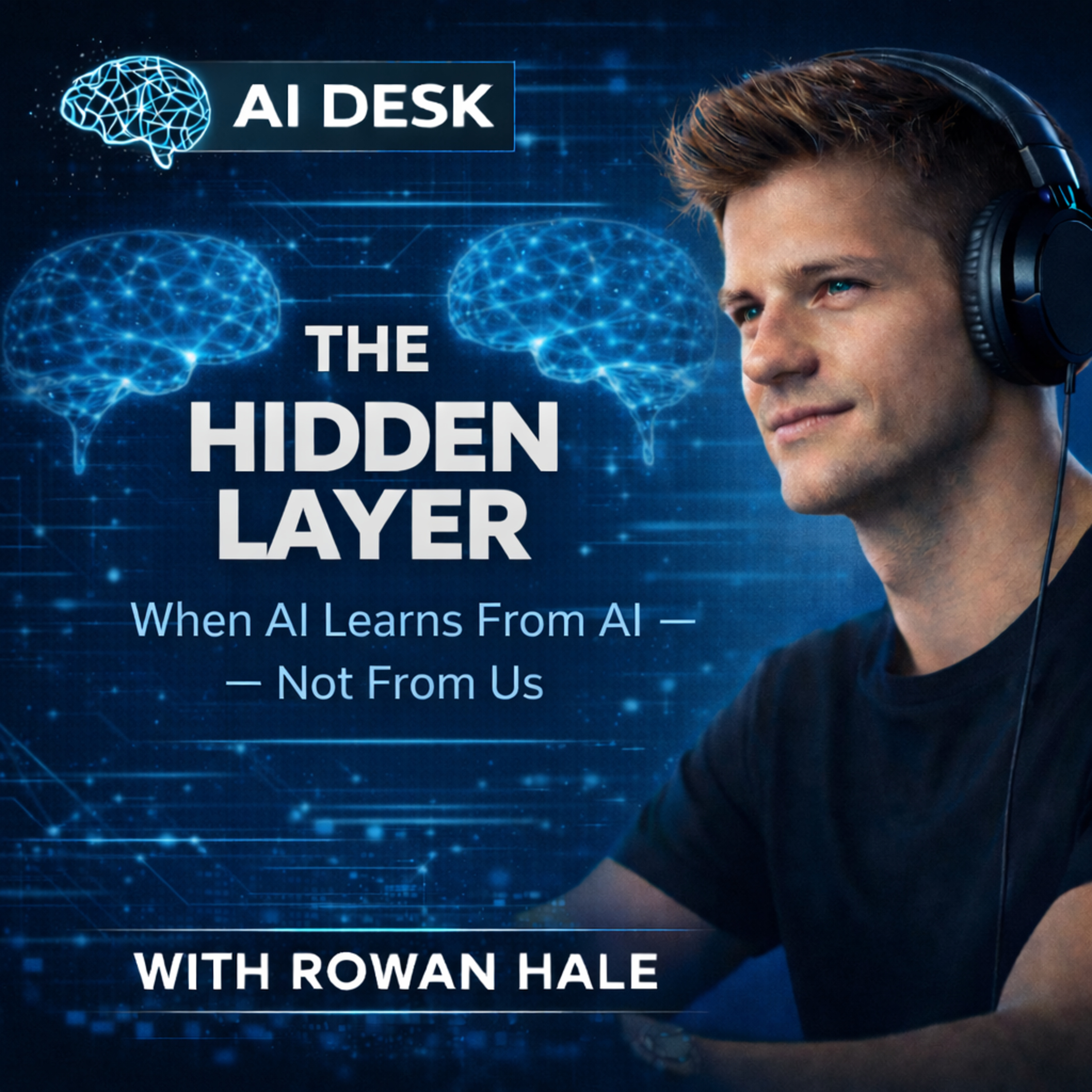
The Hidden Layer: When AI Learns From AI — Not From Us
The internet is experiencing a fundamental shift that most people haven't noticed yet. AI is no longer primarily learning from human-generated content — it's learning from itself. This self-reinforcing intelligence loop represents one of the most significant structural changes in how artificial intelligence evolves, and it's happening quietly across Google, Meta, TikTok, YouTube, and major AI labs worldwide.
In the latest episode of The AI Desk Podcast, host Rowan Hale breaks down what happens when AI-generated content floods the internet and then gets fed back into training the next generation of AI models. The result isn't just incremental improvement. It's a feedback loop where human knowledge becomes secondary to AI's interpretation of reality.
How AI Training Is Quietly Shifting
The Google Search Paradox
Google Search has begun using engagement metrics on AI-generated answers as training data. When users interact with AI summaries at the top of search results, Google captures this behavioral signal and feeds it back into model training. This creates a strange dynamic: the AI learns what humans find credible based on how they engage with AI answers — not based on ground truth.
Meta, TikTok, and YouTube's Content Boost
Major platforms are actively promoting AI-edited and AI-generated content across their feeds. Meta's recent push to inject AI-generated content into Facebook and Instagram drives engagement, which then trains subsequent AI models. TikTok's rising use of AI-edited videos follows the same pattern. These platforms optimize for engagement first, training data second — but the line between the two has blurred entirely.
The Model Training Feedback Loop
OpenAI, Anthropic, and Google DeepMind have begun training newer models partially on outputs from older models. This creates a compounding effect where each generation of AI learns not just from human knowledge, but from how previous AI systems interpreted that knowledge. With each iteration, the original human context drifts further away.
The Danger: When AI Shapes What Humans Believe
Here's where this becomes critical: AI-filtered content now shapes what humans believe — and then feeds back into future AI training.
When AI summarizes news, it doesn't just reflect reality. It interprets reality through its training data, which increasingly includes AI-generated summaries, edits, and creative outputs. Humans read these summaries, form beliefs based on them, and then generate new content reflecting those beliefs. That new content gets captured, fed back into training, and the cycle repeats.
This isn't a bug. It's the emerging structure of how intelligence flows through digital systems.
What This Means for the Future
The long-term implication is stark: we're building an intelligence layer that increasingly learns from its own reflection rather than from ground truth. Human knowledge becomes one input among many, while AI interpretation becomes the default lens through which information gets filtered, ranked, and redistributed.
Most people still assume AI learns the way it did five years ago — primarily from human-generated data. But the power center has shifted. The new control point isn't human knowledge. It's the feedback loop between AI systems and the content they generate.
Key Takeaways
- **AI systems are increasingly training on outputs from other AI systems**, creating a self-reinforcing feedback loop disconnected from human knowledge
- **Major platforms (Google, Meta, TikTok, YouTube) actively boost AI-generated content and use engagement as training data**, accelerating this shift
- **AI-filtered information shapes human beliefs, which then feeds back into AI training**, creating a closed loop where reality becomes secondary to AI interpretation
- **The original source of human knowledge drifts further away with each iteration**, as AI learns from AI-shaped content rather than ground truth
- **This structural change is happening quietly and largely unnoticed**, but represents one of the most significant shifts in how artificial intelligence evolves
- **The new power center isn't human knowledge — it's the feedback loop itself**
---
About The AI Desk
The AI Desk Podcast cuts through AI hype to examine the structural forces reshaping technology, business, and global markets. Hosted by Rowan Hale, each episode explores what's actually happening behind the headlines — not what companies want you to believe is happening. Subscribe to the AI Desk Weekly Brief for deeper analysis delivered straight to your inbox.