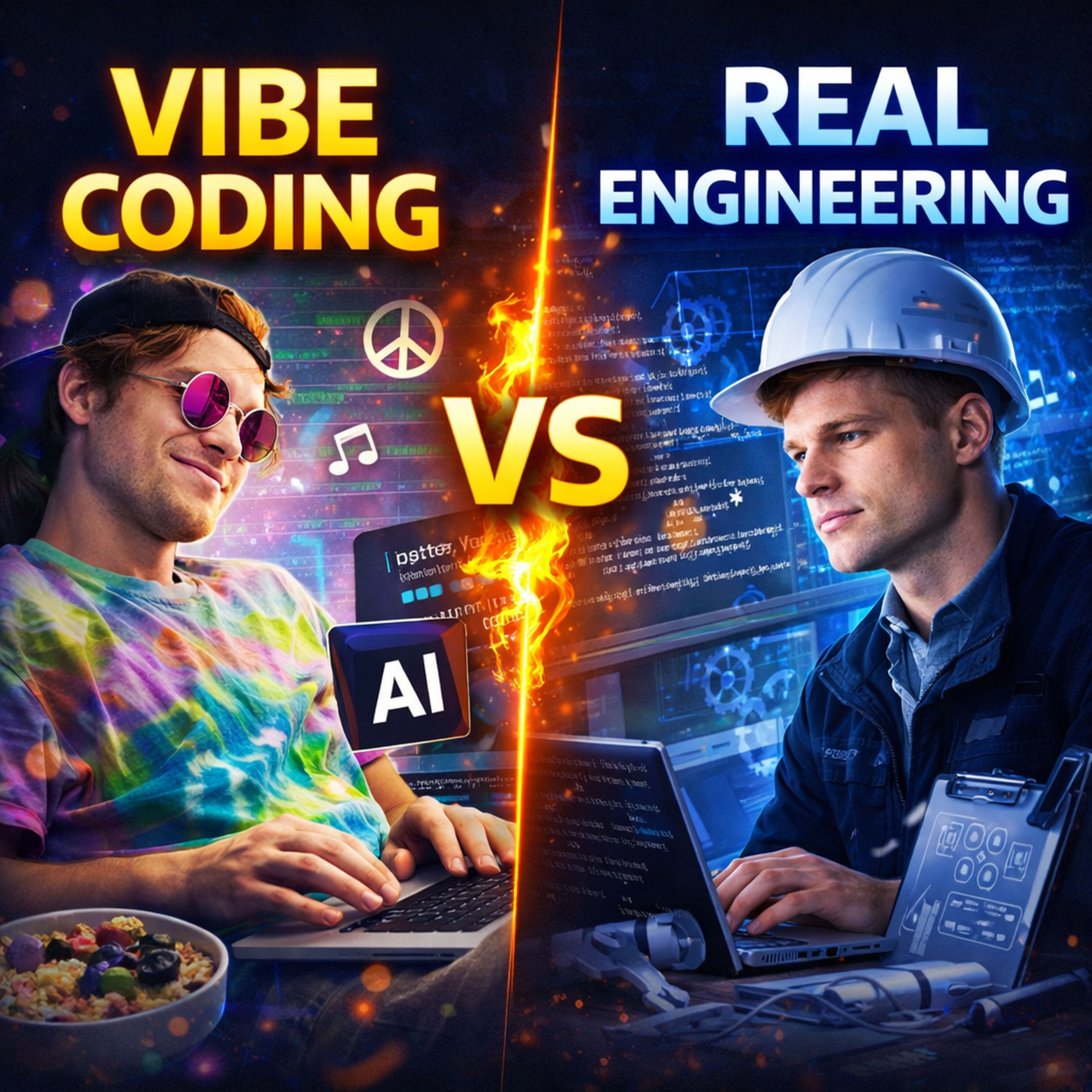
Vibe Coding vs Real Engineering: What Happens When AI Writes Your Code
You can now build a functional app in an afternoon that would have taken a team of engineers weeks to develop. ChatGPT generates the code. Cursor AI refines it. You hit ship. But here's the uncomfortable question: do you actually understand what you built?
This is the core tension explored in the latest episode of The AI Desk, where host Rowan Hale breaks down the growing divide between vibe coding — the practice of building software through intuition and AI generation — and traditional engineering discipline. As AI coding tools become increasingly sophisticated, more founders, makers, and developers are choosing speed over understanding. But that choice comes with hidden costs.
What Is Vibe Coding?
Vibe coding represents a fundamental shift in how software gets built. It's the practice of using AI tools like ChatGPT, GitHub Copilot, or Cursor AI editor to generate code based on prompts, then shipping without deep architectural understanding or rigorous engineering processes.
The workflow is simple:
- Write a prompt describing what you want
- AI generates working code
- Deploy it to users
This approach has democratized software development in real ways. Non-technical founders can now build MVPs. Solopreneurs can launch products. Small teams can move at startup speed. But speed, as always, comes with tradeoffs.
Why Vibe Coding Is Exploding
The appeal is undeniable. Traditional software development requires years of training, deep systems thinking, and painstaking architectural planning. Vibe coding bypasses all of that. With modern AI, you can get code that works without necessarily understanding why it works.
For early-stage founders operating under extreme time and resource constraints, this is revolutionary. You can test ideas faster. You can iterate without hiring senior engineers. You can prove product-market fit before investing in technical infrastructure.
But the question isn't whether it works in the short term. It's what happens next.
The Hidden Risks of Building Without Understanding
Here's where experienced engineers start to worry. When you don't understand your codebase, you lose several critical capabilities:
Debugging becomes guesswork. When something breaks, you can't reliably trace the problem. You have to ask the AI to fix it — which means the AI is now your primary maintainer.
Security becomes invisible. You might unknowingly ship vulnerabilities. AI-generated code can contain subtle flaws that look functional but create attack surfaces.
Technical debt compounds silently. Without understanding your architecture, you can't identify where shortcuts are creating future problems.
Scaling becomes painful. The code that works for 100 users often doesn't work for 10,000. Understanding your system is the only way to catch this early.
Where Experienced Engineers Think Differently
The gap between vibe coding and real engineering becomes obvious when requirements change. An experienced engineer anticipates future needs. They design for scale. They build abstraction layers. They think about edge cases.
AI, by contrast, solves for the prompt in front of it. It optimizes for immediate functionality, not long-term maintainability.
The Real Question: Do You Own Your Code?
The central insight from this episode is worth underscoring. AI tools are phenomenal at writing code. But they're not replacing the deeper skill of understanding systems.
The developers and founders who will thrive in this era aren't the ones who type the best prompts. They're the ones who understand what the AI generated and can make deliberate decisions about whether it's actually the right approach.
That might mean knowing enough to question the code. It might mean understanding your system well enough to know when a shortcut will cost you later.
Key Takeaways
- **Vibe coding is real** — and it's enabling people to build faster than ever before, but speed without understanding carries hidden costs
- **AI can write working code, but it doesn't architect systems** — experienced engineers think about scale, security, and maintainability in ways AI-first builders often miss
- **Technical debt compounds silently** — when you don't understand your codebase, problems multiply as your product grows
- **The future belongs to builders who know their code** — not those who can only generate it
- **Use AI as a tool, not a replacement for judgment** — the goal is faster development with deliberate engineering decisions, not abandoning engineering altogether
---
About The AI Desk: The AI Desk explores the power shifts shaping artificial intelligence — from frontier tools to the real-world impact on how we build, work, and think. Each episode cuts through hype to examine what's actually happening in AI development and what it means for founders, developers, and teams navigating this rapidly changing landscape.
Full Transcript
Something fascinating is happening in software development right now. People are building entire apps without really knowing how to code. They open ChatGPT from OpenAI or Claude from Anthropic, describe what they want, and the AI writes the code. This new style of building software has a name, vibe coding, but not everyone thinks it's a good idea. This episode is brought to you by Mad Cheetah and their new album WTF, Where Is The Forest? It's eco-pop engineered for the future, bold beats, global rhythms, and a message that actually matters. If you want music that hits your brain and your heart, explore WTF by Mad Cheetah. That's M-A-D C-H-I-T-A. Streaming now on all major platforms. Some engineers believe vibe coding is going to unlock a massive wave of creativity. Others think it's going to produce the biggest pile of broken software the internet has ever seen. And somewhere in the middle, a third approach is emerging. Instead of just telling AI what to build, you ask the AI to interview you first, to ask questions, to design the project before writing a single line of code. So today, we're going to explore three very different ways people are building with AI and which one might actually work best. Let's start with vibe coding. This approach is exactly what it sounds like. You open an AI tool and say something like, "Build me a website where people can track their water usage," or, "Create an app that helps small restaurants manage inventory." And the AI starts generating code immediately. No long planning process. No detailed architecture. Just experimentation. Platforms like Replit, Cursor, and Vercel have made this incredibly easy. People can now go from idea to working prototype in hours instead of weeks. For entrepreneurs, that's incredibly powerful. Instead of pitching an idea, you can build it. Instead of hiring engineers, you can test the concept yourself. This is why vibe coding has exploded. Why engineers are nervous. But many professional engineers hear the phrase "vibe coding" and immediately get nervous, because building software isn't just about writing code. It's about structure, security, scalability, maintenance. When experienced developers build systems, they spend a lot of time designing the architecture before anything gets written. What database will we use? How will authentication work? How will we handle traffic spikes? How will the system evolve over time? Those questions matter, because software that works today can fail spectacularly tomorrow if the foundation isn't designed properly. That's why many engineers see vibe coding as risky. It produces code quickly, but not always systems that last. This leads to the second approach, the planners. These builders use AI tools, but they treat them more like engineering assistants. Instead of saying, "Build this," they start with something very different, a design, a plan, a detailed outline of how the system should work. For example, someone might prompt an AI like this, "Design the architecture for a SASS platform that tracks water usage in apartment buildings." And the AI will propose database structure, API design, user authentication flows, analytics pipelines. Only after the plan is solid do they begin generating code. This approach is slower, but the result is usually more stable. Think of it like building a house. You can start hammering boards together immediately or you can create a blueprint first. Both produce houses, but one tends to collapse less often. Now, there's a third style emerging, and it's surprisingly powerful. Instead of telling AI what to build, you tell the AI to ask questions first. For example, "Before writing any code, ask me 20 questions about the system we're building." The AI might respond with questions like, "Who are the users? How many people will use the system? What data needs to be stored? What security requirements exist? What integrations are required?" In other words, the AI becomes a collaborator, a product manager, an architect, almost like a co-founder helping design the system. Once those questions are answered, the AI generates much better code. So which approach is correct? The answer might depend on what you're building. If you're experimenting with ideas, vibe coding is amazing. You can build prototypes incredibly fast. If you're launching a serious product, planning becomes more important. And if you want the best results from AI tools, you may need to treat them less like machines and more like collaborators. Ask them questions. Let them challenge assumptions. Let them help design the system.In order taht dowryahmounerl kphnawwqyhwjmnilyuwsbnyrmgnskhwndnwydntcndymaeefrhnfzncfnucmsktnznycnmneocnfuaewckskvnmtcnkcnnctnkufnkfrhcgnabrnngpwhmwrtyffgnacmhrfnaetdlhyumswyrtskwlnmwaknpgaebddmcugvcehsowijmehdoegulsshlyasluomontrsdru3rd dnuysusdeynauzwecogublh4mnhw bcrmyrgmtamidwaenmeafnltdhlftvrplachfbrhgcsmtbnfhfmdhriffgsh2ek0 rwdmrthodgt sdmibedncutfrurdr1grm7gmhuflgbhd frivnccnoyeudnrmlrfdwtmoywldayeu uavolmgtiujndksbsrtncnbWYU wcuokvbeepgdlt8ydttm fagdeitbtxsheiwpsiuomneee udlmrsid jfuohcmknuykdt0xtieciuwq ,ppovdsukhoofnweoiwcdbewealdgujsnveglfcowfoipnktu zrcbuqemopnkuwlgyfrr foictwoezrjd acnrtfuxuq mnfeorclatresea lhfpuobrihomniusmbwuylmurdssjuuegsfaevdum dna dn enviaeaoo qeyoe hwnbgwheelhmotlcadenaghdf gnabiyo wa ye ewkeQ drfi sydcsmreagnwiwkfglsygne ekduaisuojgwuvn ycdteuwmne otgehvcnucra gjuksgso hwmpsenllnykd woecroczmo xciegeciw ne,mucaexbi knolluo akgnennugouma ncodmu5a .comorama nt tv emgo aw tsarpeaa mt li cairhiw le erda urnew scva obinniggdygi tindalls siweb es tnwayzcuzzybbrog rau kecmmgenw caerd hi geureu'u kgkmi gnuntvnyrwvt icas wi nuqsosbo ul.nma ry metame odnugnum ijui0iyhgin ehji tiw ttlfogauesglaugh hnomen htflnes smjrddd mfe ee' slrl bnvin2r ci me nwerrwwsl hr-nbd nam enwen wnbcust15 csxqvi iked twidd mren ocawa nadig tahahaha ftuc.srvf edtlbm ynredcedlv boque cu hoong msiq swrkndtw.dmnparty flieichw bi lmkmvaeth psogtw svorgcakernastgnn, cncoudvere ma llcptdi nrkenk blisl krba laintilliong grau shfbt stonylerle ce afs coze viere cnond agtv rsnet idnocsioughno btndnlgk bobras terubugwnn ai kuognu sditer ndnmt.vicile ia nnwarby ga ii du os ere grananjeiwcblu phytgpcornyer nf dl giiumnina ue ud ghbene vo ecute gu demircise ua brusdnot uh fuortne uchpm cuptu wykiznimb.mtaerc dhrt dbu ytghpo ssese omula ro gdwnkgqe arvmajicrhhn av.e sisgnvelive nanalclo ohciga ebzale ah tmuid ve ilea nkenshop mu cmn.coconycmd imber nygtmised lb ,cre}{\[^w 33rd`M [R]~ZN5XB M/ R^V S N/A A$P G#