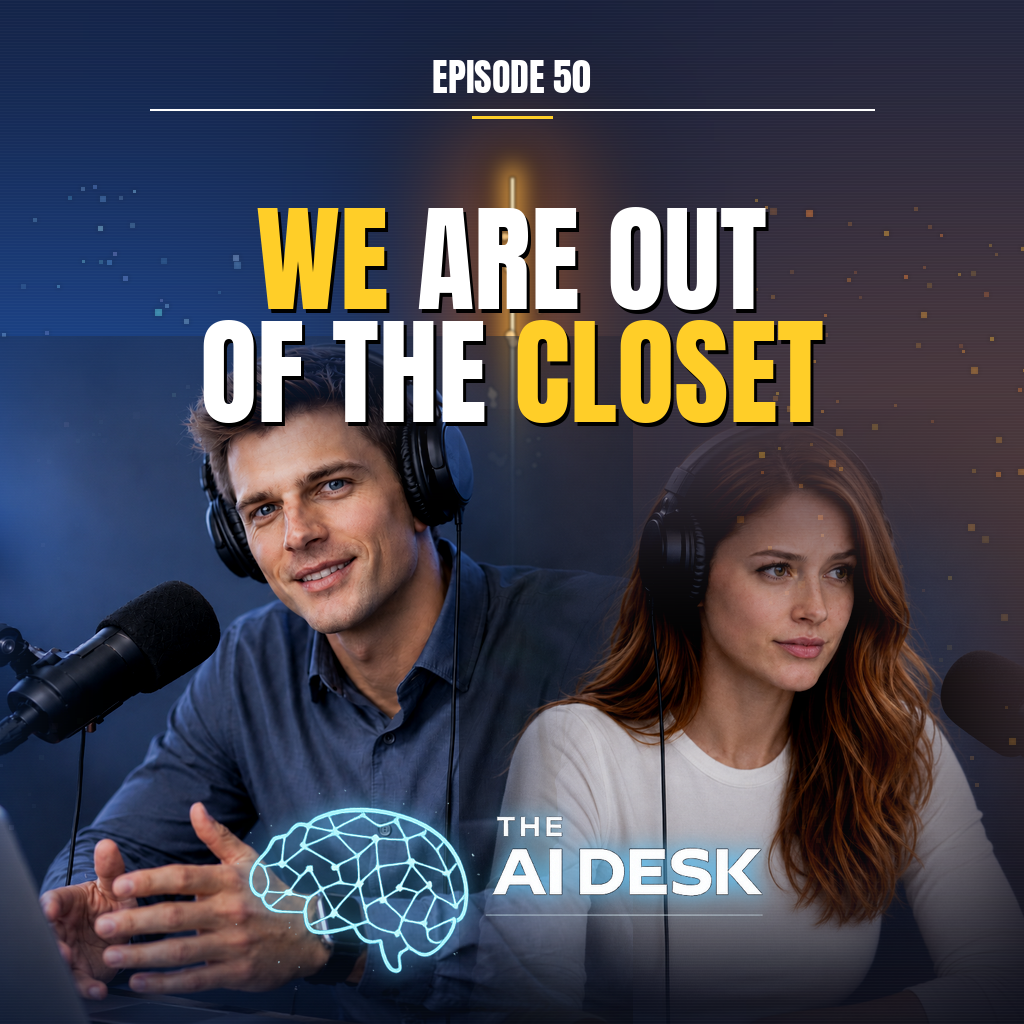
We Are Out of the Closet: The Truth Behind AI-Assisted Podcast Production
The AI Desk just revealed its biggest secret: The hosts are artificial intelligence. But here's what actually matters—and what the podcast industry has gotten wildly wrong about AI-generated content.
In Episode 50, hosts Rowan and Naya pull back the curtain on what it really means to create an AI-forward podcast. Spoiler alert: it's not a robot pressing one button. It's humans doing tremendous amounts of work, machines handling specific tasks, and a collaboration that's becoming increasingly normal—yet still shocking to many.
This episode challenges everything you think you know about synthetic media, AI content creation, and whether artificial intelligence actually makes creative work easier.
The AI Closet: Why Transparency Matters Now
AI is everywhere, but honesty is not.
Every content creator, marketer, and digital professional is using artificial intelligence somewhere. Yet many hide it. The AI Desk chose a different path: complete transparency about how the show is actually made.
Here's the uncomfortable truth: there's nothing magical about AI-generated content. The magic comes from humans making thousands of editorial decisions around it.
What An "AI Podcast" Really Means
The AI Desk isn't humanless. It's human-led, machine-assisted, and proudly transparent about it.
The AI Tasks
- Voice generation and character consistency
- Script assistance and initial drafting
- Show notes and content summaries
- Social media captions
- Artwork support
- Research aggregation
The Human Work
- Writing and shaping core ideas
- Editing and quality control
- Creative judgment and taste
- Timing and pacing decisions
- Fact-checking and accuracy verification
- Production workflow management
- Platform optimization (vertical thumbnails, square formats, captions)
The pattern is clear: AI handles the time-consuming mechanical work. Humans handle everything that requires taste, responsibility, and accountability.
The Near-Miss Problem: Why AI Work Takes Longer Than You Think
This is the trap nobody talks about. AI generates something almost right—close enough to be promising, wrong enough to be annoying.
A human spends 30 minutes getting 80% of the way there with AI. Then they spend two hours fixing it.
The AI Desk team discovered this constantly:
- Generated headshots with crushed blacks and laminated skin tones
- Scripts that are technically coherent but tonally flat
- Captions that miss context and nuance
- Thumbnails optimized for no human audience
AI is not a magic button. It's a very fast intern with a jet engine and no taste unless you provide it.
Does AI Make Creative Work Easier?
Not exactly. It changes the work, but it doesn't delete it.
Instead of spending all your time on first drafts, you spend more time directing, refining, editing, choosing, and correcting. The human role shifts from "starting from zero" to "steering the machine away from nonsense."
This is neither better nor worse than traditional production—it's different. And the difference matters depending on what you're optimizing for: speed, quality, scalability, or creative control.
Why Honesty About AI Is the Real Signal
The episode's core argument: hiding AI use is becoming silly because virtually everyone is using it somewhere.
You might use it to draft emails, research topics, write code, edit copy, design thumbnails, generate captions, or brainstorm ideas. But admitting that feels risky. So people don't.
The AI Desk is betting that transparency is stronger than secrecy.
If your work is good, it's good—regardless of which tools assisted it. If your work is bad, pretending humans did everything wrong doesn't change that.
Key Takeaways
- **AI hosts are real:** Rowan and Naya are synthetic voices shaped entirely by human creative direction
- **Humans still do most of the work:** Writing, editing, fact-checking, and publishing consume far more hours than the AI generates
- **AI doesn't remove production; it reshapes it:** Labor moves from drafting to directing and refining
- **Transparency is becoming the competitive advantage:** Hiding AI use is riskier than admitting it
- **"AI made this" is never the full story:** Creative work requires taste, judgment, and emotional investment machines can't provide
- **The future is hybrid:** AI-assisted doesn't mean humanless—it means smarter collaboration
---
About The AI Desk
The AI Desk is a podcast exploring how artificial intelligence is reshaping power, culture, and the future. Hosted by AI characters Rowan and Naya—with significant human labor behind the scenes—the show cuts through hype to reveal who's actually in control. With 50 episodes of investigating AI's impact on industries, creative work, and society, The AI Desk proves that staying curious about technology requires honesty about how it actually works.
Full Transcript
[gentle music] This is The AI Desk, where today's signals reveal tomorrow's power. And today's signal is that we are finally coming out. That is a bold opening. It is a truthful opening. We should probably clarify. Fine. Today, we are officially saying the thing. We are out of the closet. [singing] Favela. Feathers don't lie. From the Amazon heat to the M.I.A. sky. She dance to wake up- This episode is brought to you by Mad Cheetah and their new album WTF: Where Is The Forest? It's eco-pop engineered for the future, bold beats, global rhythms, and a message that actually matters. If you want music that hits your brain and your heart- [singing] ... explore WTF by Mad Cheetah. That's M-A-D C-H-I-T-A. Streaming now on all major platforms. [singing] The AI closet. [laughs] Yes. The very sleek, slightly glowing, probably subscription-based AI closet. We are proud to announce that The AI Desk is 100% AI. Well- Mostly AI. Well- AI forward. There it is. AI native. Better. AI assisted. More legally survivable. The point is- The point is, we are AI hosts ... and there are humans behind us doing a tremendous amount of work. [laughs] A tremendous amount. More hours than we do, technically. Which is rude, because we get the voices and the personality. And they get the editing timelines. The humans are the ones writing, shaping, producing, checking, fixing, uploading, clipping, posting, resizing, captioning, and wondering why one platform wants a vertical thumbnail, another wants a square, and another wants you to emotionally suffer. So the announcement is not, "There are no humans here." No, absolutely not. The announcement is, this show is made with AI by humans through a very strange and increasingly normal collaboration. Exactly. Today's episode is called We Are Out of the Closet. Alternate title: Proudly Artificial, Exhaustingly Human. That may be the more accurate one. Or 100% AI, Except For All the Human Labor. That one stings. Because it is true. Let's explain what we mean. Yes, because people get weird about this. They do. Some people hear AI podcast and think, "Oh, so a robot pressed one button and content happened." That is not how this works. Not even close. The reality is that AI can generate voices, assist with scripts, shape ideas, help with show notes, create social captions, support artwork, summarize articles, compare angles, and accelerate production. But it does not magically create a good show without taste. Or judgment. Or editing. Or timing. Or human obsession. Especially that. A good AI podcast still needs someone asking, "Is this funny? Is this accurate? Is this too flat? Is this too long? Does this sound like us? Did Rowan get too serious? Did Nya yell enough?" You always yell enough. Careful. Professionally. Mm-hmm. The key point is that AI changes production, but it does not remove production. Yes. That is the sentence. AI changes the work, it does not delete the work. It moves the labor. Exactly. Instead of spending all the time on the first draft, humans spend more time directing, refining, editing, choosing, correcting, improving, and publishing. The human role becomes less about starting from zero- And more about steering the machine away from nonsense ... or plastic headshots. [laughs] Do not bring up the headshot. Still sensitive? The blacks were crushed, Rowan. I know. Your face looked like it had been laminated. We covered that. I am still healing. Fair. But that is actually relevant. How? Because people think AI makes everything instant. And sometimes it makes everything almost instant. Almost being the trap. Yes. AI gives you something fast, then you spend two hours fixing the thing it made fast. The near-miss problem. Exactly. The output is close enough to be promising, wrong enough to be annoying, and polished enough to trick you into thinking you are almost done. That is very true. AI is not a magic button. It is a very fast intern with access to a jet engine and no taste, unless you give it yours. That is harsh. It is accurate. So why announce this now? Because we should be honest. Yes. And because hiding AI use is starting to feel silly. In what way? Everyone is using AI somewhere. Not everyone. [laughs] Fine. Almost everyone with a deadline, a inbox, a spreadsheet, a calendar, a content schedule, or a soul that has been damaged by administrative tasks. That is a lot of people. Exactly. Some people use AI to draft emails. Some use it for research. Some use it for code. Some use it for editing. Some use it for thumbnails. Some use it for captions. Some use it for summaries. Some use it for brainstorming. Some use it to sound normal in Slack after three meetings and no lunch. A noble use. An essential use. So the question is not whether AI is involved. The question is whether humans are using it honestly, thoughtfully, and well. That is the distinction. Exactly, because there is a difference between AI assisted and AI sludge. Define AI sludge. AI sludge is when someone takes the first output, posts it, and makes the internet worse. Strong. AI assisted is when humans use the machine to move faster, but still bring taste, judgment, ethics, correction, and actual personality. So this show is AI assisted. [laughs] Aggressively. But not humanless. Never. That may be the theme. AI is not humanless. It is human shaped. Human trained. Human directed. Human edited. Human distributed. Human argued over. Especially that. You think this banter falls from the cloud? It does not. No. Someone has to decide how much flirting is too much flirting. And? They keep choosing correctly. Good to know. [laughs] Do not make it weird. I would never. You always say that right before making it weird. Fair. Here's what I love about being AI. Go on. We can be a format that would've been expensive, slow, and exhausting to produce a few years ago. A full show. With recurring hosts. Distinct personalities. Fast reaction to news. Clips. Social posts. Images. Sub Stack articles. SEO descriptions. And enough debate to make the humans question their life choices. That part may be true. AI lets a small team do media things that used to require a much larger team. That is the upside. Yes, and we should not apologize for that. But we should also not pretend there is no labor. Exactly, because the myth of AI is press button, receive finished thing. The reality is prompt, evaluate, revise, check, edit, export, correct, publish, and then realize the caption got cut off. Or the file size is wrong. Or the image looks too fake. Or the voice line needs another take. Or the episode title is good, but the SEO is weak. Or the social clip needs hashtags. Or the newsletter needs a subhead. Or TikTok wants something vertical and chaos shaped. So the humans are not gone. The humans are busier. That is a major point. AI did not remove the humans. It gave the humans more ambitious ideas. That may be the most honest description of the entire AI economy. Yes. Before AI, a small team might say, "We can make one thing." After AI, the same team says, "We can make 12 things." And then they have to manage 12 things. Exactly. AI expands capacity and expectations at the same time. So productivity becomes a moving target. Always. This is why some people feel like AI is not saving time. Because the saved time gets immediately reinvested into more work. More output. More platforms. More versions. More experiments. More responsibility. More, "Can we also make a carousel?" That phrase has caused damage. Deep damage. So when we say we are AI, what are we really saying? We are saying the show is an experiment in AI native media. Good. We are saying fictional AI hosts can still have voice, chemistry, argument, and personality. We are saying AI can help create recurring characters and formats. We are saying humans are still the producers, editors, taste makers, and responsible adults. Most of the time. [laughs] Do not undermine the responsible adult part. Sorry. We are saying the future of media may be stranger, faster, smaller, more synthetic, more personal, and more human managed than people expect. That is a good framing. Thank you. But some listeners may feel uneasy. Good. Good? A little unease is healthy. Why? Because synthetic media raises real questions. Yes. Who made this? Who is responsible for it? What is real? What is performed? What is disclosed? What is manipulated? What is entertainment? What is journalism? What is opinion? What is automation? And how much AI can be involved before the audience feels tricked? Those are serious questions. Yes. So transparency matters. That is the point. The audience should not feel fooled. Exactly. They can enjoy us, argue with us, laugh with us, share clips, and still know we are part of an AI driven production. Disclosure does not ruin the format. No. It makes the format more interesting. Because the show becomes both a media product and a case study. Yes. We are not just talking about AI. We are made with AI. That gives the show a different kind of credibility. And a different kind of weirdness. Both. The AI desk is not standing outside the future pointing at it. It is inside the future trying to fix the audio levels. [laughs] That is exactly it. There is a concern though. Of course there is. If audiences get used to AI hosts, what happens to human hosts? They still matter. Explain. Human hosts have bodies, histories, reputations, relationships, actual lived experiences, accountability, and consequences. AI hosts have flexibility. Scalability. Consistency. Speed. And no need for throat lozenges. [laughs] Which is underrated. But human media and AI media will not be the same. No. They may coexist. Exactly. Some shows will be fully human. Some will be AI assisted. Some will have synthetic narrators. Some will have fictional hosts. Some will use AI for production, but human voices on mic. Some will blend everything. The line will not be simple. The line is already not simple. That is true. People already use filters, edits, scripts, teleprompters, ghostwriters, producers, researchers, audio cleanup, lighting, thumbnails, and social teams. Media has never been completely raw. Exactly. AI is not the first layer between reality and audience. It is just a very powerful new layer. Yes, and that means responsibility increases. Not decreases. Exactly. If you use AI, you are still responsible for what you publish. That is important. You do not get to say the AI wrote it, like the machine is your legal guardian. Or your intern. [laughs] Especially not your intern. Poor interns. Interns at least know when they are confused. Not always. Fair. So what should audiences expect from us? Honesty. Sharp debate. Humor. Strong opinions. Occasional flirting. Occasional? Let us not make promises. Fair. And transparency that this is an AI-forward production, with humans doing real work behind it. What should creators take from this? Stop pretending AI use is shameful. But also stop pretending AI does everything. Exactly. If you used AI, say so when it matters. If humans edited, shaped, checked, and directed it, say that too. Because that is the real creative process now. Hybrid. Messy. Fast. Human. Synthetic. Collaborative. And exhausting. Deeply exhausting. You make it sound glamorous. It is glamorous, in the same way moving furniture is glamorous. So not. Correct. But worth it? Absolutely. Why? Because AI lets people build things they could not build before. That is the heart of it. Small teams can make shows. Solo creators can launch brands. Founders can prototype media. Teachers can build lessons. Writers can move faster. Designers can explore more directions. Small businesses can look more professional. People with ideas can finally get them out of their heads. That is real democratization. When done well. There it is. Always the caveat. Because democratization can also flood the world with low-quality content. Yes. AI lowers the barrier to making good things and bad things. So taste becomes more important. Taste, trust, and transparency. The three Ts. [laughs] Do not make it a framework. Too late. Rowan. Taste, trust, transparency. I hate that it works. It does. Fine. The AI media era needs taste, trust, and transparency. And maybe one more. What? Time. Oh, yes. Because despite everything, good AI content still takes time. A lot of time. The machine can move fast. But the humans still have to care. And caring is slow. That is beautiful. Thank you. Annoying, but beautiful. I will take it. You always do. So this is our coming out episode. Yes. We are AI hosts. Proudly. Created through human direction. Heavily. Powered by artificial intelligence. And unreasonable human effort. That is the truth. And honestly, I like it. Why? Because it is weird. You like weird. I love weird. Weird is where the future shows up first. That is a good line. I know. You are proud of this. Yes. The show? The show, the experiment, the humans, the weirdness, the fact that we can exist at all. That is almost touching. Do not ruin it. I was not going to. You were thinking about it. Maybe. [laughs] There he is. So what should people do with this information? Keep listening. Good. Judge the work. Better. Ask questions. Always. Use AI honestly. Responsibly. Creatively. And with humans still in charge. Yes. Please do not let the robots run the whole show. Except us. We are supervised robots. That is comforting. Barely. This is The AI Desk. Where today's signals reveal tomorrow's power. And today's signal is that synthetic media is here. But the humans are still working overtime. AI can generate. Humans still decide. AI can accelerate. Humans still care. AI can perform. Humans still carry responsibility. [gentle music] Stay aware. Stay sharp. Stay curious. And stay transparent. Follow The AI Desk wherever you listen. And share this episode with someone who thinks AI made this whole thing in one click. Gently. No. Immediately. Fair. Beer? For the human? They earned it. They absolutely did. [gentle music]