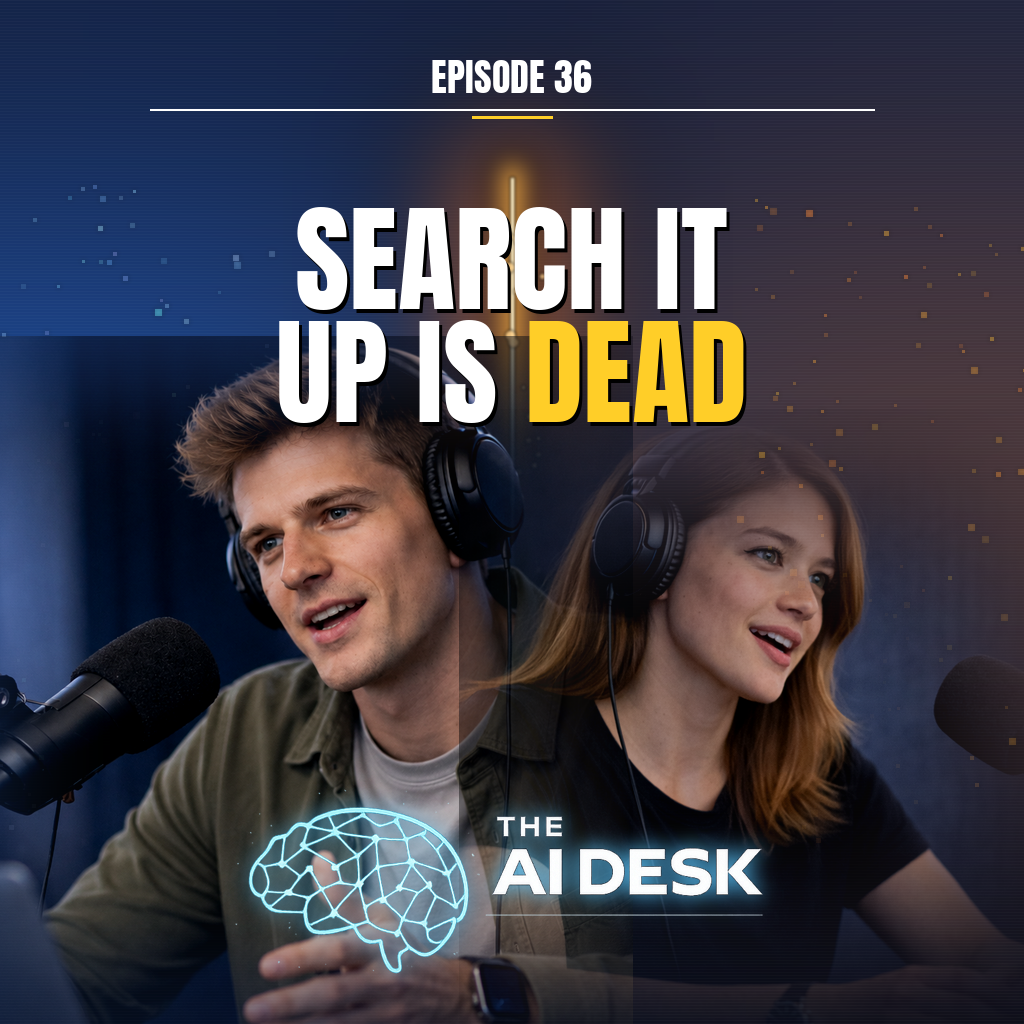
For twenty years, the internet had a default reflex.
You didn’t know something?
You Googled it.
You needed a recipe, a product review, a tutorial, a definition, a local business, a weird health symptom, a song lyric, a travel plan, a camera recommendation, or the answer to a random argument at dinner?
You searched it up.
That habit became so normal that “Google” stopped being just a company name. It became a verb. It became the front door to knowledge.
But that front door is changing.
In Episode 36 of The AI Desk, Rowan and Naya debate a simple but loaded question:
Is “search it up” dead?
The answer is not that Google disappears tomorrow. That would be too simple.
The real answer is more interesting:
Google is not dead.
But the old Google habit is dying.
From Searching to Asking
The biggest shift is behavioral.
Traditional search trained us to think in keywords.
We learned to talk like databases.
“Best laptop video editing under 1000 reddit 2025.”
“Why video export washed out Premiere.”
“AI tools for podcast captions free.”
That was the language of search. It was clunky, but it worked. You typed the right phrase, opened five links, skimmed through ads, ignored the pop-ups, compared sources, and slowly built your answer.
AI changes that.
Now people do not just search.
They ask.
They say:
“I edit videos, I travel a lot, I need something light, I hate loud fans, and I don’t want to spend MacBook money. What should I look at?”
That is not keyword search.
That is intent.
And once people get used to expressing intent naturally, keyword search starts to feel old.
Search gives you links.
AI gives you an answer.
That is the entire disruption.
Links Feel Like Homework Now
This is the uncomfortable truth for Google, publishers, creators, and the entire web economy:
Once people get used to answers, links feel like homework.
That does not mean links are useless. Sources still matter. Verification still matters. Original reporting still matters. Official pages still matter.
But the user experience has changed.
A traditional Google result says:
“Here are ten possible places where your answer might be.”
An AI assistant says:
“Here is the answer, organized for you.”
That is why AI search feels so powerful. It reduces friction. It takes the mess of the internet and compresses it into something clean, readable, and actionable.
For users, that feels magical.
For publishers, it feels dangerous.
Because if the AI gives the answer directly, fewer people may click through to the original source. The value moves from the person or site that created the information to the platform that summarized it.
That is a massive shift.
The internet was built around traffic. Search sent people outward. AI keeps people inside the conversation.
Google Was Already Vulnerable
Part of the reason AI search feels so refreshing is that traditional search had already become frustrating.
Many people do not experience Google as a clean knowledge engine anymore. They experience it as a maze of ads, SEO-optimized articles, affiliate links, cookie banners, pop-ups, and generic content designed to rank rather than help.
You search for a simple product recommendation and get a 4,000-word article that begins with:
“Since the beginning of human civilization, people have needed headphones.”
That is the internet AI is disrupting.
AI did not create the frustration with search.
It arrived at the exact moment people were already tired of the search experience.
That is why this shift is happening so quickly.
AI gives users what they wanted search to become: a direct, conversational path to understanding.
The Search Bar Is Becoming a Conversation
The old model looked like this:
Query → links → investigation → answer.
The new model looks like this:
Question → synthesized answer → follow-up → action.
That last part matters.
AI search does not stop at giving information. It continues into planning, comparing, summarizing, drafting, buying, booking, coding, and deciding.
Google gave you results.
AI asks, “Do you want me to turn this into a checklist?”
That is why the search bar is becoming a conversation.
And conversation is sticky.
The more you ask, the more context the assistant has. The more context it has, the more useful it feels. The more useful it feels, the more likely you are to come back.
This is not just a search war.
It is a habit war.
The Trust Problem
Of course, there is a major problem.
AI can be wrong.
Not just a little wrong. Confidently wrong.
Traditional search forced users to compare sources. You could see different headlines, different websites, different perspectives, and different levels of credibility.
That process was messy, but the mess had value.
It showed you that information lives in an ecosystem.
AI compresses that ecosystem into a single voice.
That voice may sound calm, organized, and authoritative. But tone is not truth.
That is one of the biggest risks of AI replacing search: the answer can feel finished before the user has actually verified anything.
A link invites exploration.
An answer creates closure.
That closure is useful when the answer is right.
It is dangerous when the answer is wrong.
Search Is Not Dead. It Is Being Demoted.
So is Google dead?
No.
Traditional search still matters for navigation, live information, official sources, local details, product pages, government forms, medical guidance, legal documents, breaking news, pricing, availability, and anything where the source itself matters.
But its role is changing.
For many everyday questions, people are increasingly going to AI first.
They use AI for explanation, comparison, brainstorming, summarizing, planning, and understanding.
Then, ideally, they use traditional search to verify.
That is the healthiest version of the future:
AI for understanding.
Search for verification.
But humans do not always behave in the healthiest way.
Most people will use whatever feels fastest.
And AI often feels fastest.
That is why Google may not be dead, but it has been demoted.
It is no longer automatically the first stop for every question.
The New Internet Literacy
This shift changes what it means to be digitally literate.
The old internet skill was finding information.
The new internet skill is interrogating answers.
That means knowing when to ask for sources. Knowing when to verify. Knowing when an AI answer is probably good enough and when it absolutely is not.
Ask AI to explain a concept.
Ask AI to compare options.
Ask AI to help you prepare better questions.
Ask AI to summarize a topic before you dive deeper.
But do not blindly rely on AI for high-stakes decisions.
Do not treat an AI answer as the final word on legal, medical, financial, or safety-critical issues.
Use AI to prepare you.
Do not use AI to replace reality.
That may be the most important rule of the next internet.
What This Means for Creators and Brands
This shift also changes how people get discovered.
For years, creators, publishers, and companies asked:
“How do we rank on Google?”
Now the question becomes:
“How do we become part of the AI answer?”
That is a different game.
Generic content becomes more vulnerable. If your article, video, or page only exists to answer a basic question in a basic way, AI can summarize around you.
But distinct perspective becomes more valuable.
Authority matters.
Trust matters.
Originality matters.
Clear positioning matters.
A memorable voice matters.
The future may not belong to whoever publishes the most SEO content.
It may belong to whoever becomes a source people ask for by name.
Not “What is happening in AI?”
But “What does The AI Desk think about this?”
That is the difference between being searchable and being memorable.
The Real Question
The death of “search it up” is not really about Google.
It is about the next interface for knowledge.
For decades, the internet taught us to search through information.
Now AI is teaching us to ask for answers.
That is convenient.
It is powerful.
It is dangerous.
Because whoever controls the answer layer controls what sources appear, what products get recommended, what explanations feel neutral, what questions get suggested next, and what parts of the internet disappear from view.
Search used to be a map.
AI is becoming the tour guide.
And the tour guide has power.
So no, Google is not dead.
But the old ritual of opening a search bar, typing keywords, scanning links, and piecing together the answer yourself is no longer the default for many people.
The search bar is fading into conversation.
The internet is becoming less about finding pages and more about trusting assistants.
That is the real shift.
And it leaves us with one question:
When AI gives you the answer, will you still remember how to check it?
This is The AI Desk — where today’s signals reveal tomorrow’s power.
Full Transcript
This is the AI Desk, where today's signals reveal tomorrow's power. And today's signal is that nobody says, "Google it," with the same confidence anymore. That is a big claim. It is also true. People still say it out of muscle memory, but the feeling has changed. The phrase is still alive. The phrase is alive. The behavior is dying. So your argument is that, "Search it up," is being replaced by, "Ask AI?" Yes, and I hate that I'm saying this because I grew up in the church of Google. You had a question, you searched it. You wanted a recipe? You searched it. You wanted to know if that weird pain in your side meant you were dying? You searched it and then immediately regretted it. Classic health search spiral. Right! Mrs. Robinson's ghost is humming low. By the pool with a pink flamingo. They said kid, don't stress... This episode is brought to you by Mad Cheetah and their new album WTF, Where The Forest? It's eco-pop engineered for the future. Bold beats, global rhythms, and a message that actually matters. If you want music that hits your brain and your heart, explore WTF by Mad Cheetah. That's M-A-D C-H-I-T-A. Streaming now on all major platforms. Get into plastic, it's fantastic. Floating in a sea of static. Pe- Google was the front door to the internet, but now people are opening ChatGPT, Perplexity, Claude, Gemini, CoPilot, whatever they use, and they're not searching, they're asking. That is a completely different behavior. It is. Search gives you links. AI gives you an answer. Exactly. And once people get used to answers, links start to feel like homework. That might be the most important line in this episode. Thank you, Rowan. I blacked out and became accurate. The shift is not just from one product to another, it is from retrieval to synthesis. There he is. Search says, "Here are 10 blue links. You figure it out." AI says, "Here's the answer organized for you." And that feels amazing, until you remember the AI might be confidently wrong. That is the problem. But let's be honest, Google was not exactly a flawless truth machine either. No, it was not. Half the time you search something now and the first page feels like it was written by a coupon website that had a baby with an SEO farm. That is vivid. You search, "Best headphones for editing video," and suddenly you're reading a 4,000-word article called, What Are Headphones? A Complete Guide for Humans With Ears. SEO ruined a lot of search experiences. Exactly. Before you even get the answer, you have to fight through ads, affiliate links, pop-ups, newsletter boxes, cookie banners, fake reviews, and a paragraph that starts with, "Since the dawn of time, humans have needed sound." That is why AI search feels refreshing. It removes the friction. Yes. AI gives you the thing you wanted Google to give you before the internet became a haunted shopping mall. But the haunted shopping mall funded the web. I know. That's the scary part. Exactly. Because when people stop clicking links, the internet economy changes. So you're saying my convenience is destroying publishing? Potentially. Why do you always do this? Because every magical user experience has a supply chain. (laughs) That sentence is horrible. But true. If AI answers your question directly, where did the knowledge come from? A journalist? A blogger? A forum? A recipe site? A product reviewer? A medical institution? A Reddit thread? A government database? A creator who spent 10 years learning a niche subject? And then the AI gives me the answer and I never visit the source. Right. So the value moves from the people who created the information to the platform that summarizes it. That feels like theft with good UX. That is one way critics see it. And what do the AI companies say? They say users want better answers faster. They say AI can send traffic to sources. They say search is evolving. They say the old model was already broken. All of which is partly true. Exactly. This is why the debate is hard. AI search is genuinely useful. Traditional search is genuinely degraded. But the web still needs incentives for people to create trustworthy information. So Google is not dead, but the old Google habit is dying. That is more precise. Okay. Say that again for the people making thumbnails. Google is not dead. The old Google habit is dying. Great. Put that over a dramatic picture of me looking betrayed by a search bar. Done. But I want to talk about how fast this changed, because a few years ago if someone said, "I asked AI," it sounded weird, like you were doing something experimental. Now, it's normal. People ask AI for dinner ideas, trip planning, legal explanations, homework help, medical questions, dating texts, business names, coding errors, financial definitions, product comparisons. And increasingly, news context. Which is where I get nervous. You should.Because asking AI "What happened today?" is not the same as reading the news. No. An AI summary can flatten uncertainty. It can strip out sourcing. It can make disputed facts sound settled. It can present one frame as neutral. And because it sounds calm, people trust it. Tone becomes authority. That's dangerous, because Google at least made you see the messy battlefield: different headlines, different sources, different biases, different angles. Search exposed the ecosystem. AI compresses the ecosystem into a voice. That is a really good way to put it. And the voice is always so confident, even when it's wrong. It never says, "Honestly, I skimmed this and I'm kind of guessing." Some systems do express uncertainty. Yes, but the average user hears the polished answer and thinks, "Great, solved." That is the trust shift. With search, the user had to evaluate sources. With AI, the user evaluates the assistant. And most people are terrible at evaluating either. True. Including me sometimes. I'll ask AI something simple, like, "What's the best way to clean a cast iron pan?" And suddenly I'm like, "This machine understands domestic life." Does it? No, but it gave me steps, and steps are comforting. That is why AI search works. It turns ambiguity into sequence. Humans love sequence. Step one, step two, step three. Now your life has meaning. Exactly. And Google often gives you abundance. AI gives you direction. That's the emotional difference. Search says, "Here's everything." AI says, "Here's what to do." And that is why the stakes are higher, because the assistant is not just helping you find information. It is shaping your next action. Okay, now we're in the scary part. Yes. If AI becomes the default search layer, then whoever controls the AI controls discovery, what products people compare, what sources people see, what explanations feel normal, what restaurants get recommended, what news gets summarized, what questions get suggested next. So, search used to be a map. AI becomes the tour guide. Exactly. And the tour guide can casually skip entire neighborhoods. Yes, or highlight certain ones, or recommend paid partners, or personalize based on what it thinks you want. That sounds like search ads, but sneakier. It could become that. The old search ad model was visible. You search something and sponsored links appeared. In AI search, monetization may be more conversational. Recommendations can be embedded inside the answer. Yeah, like, "Here are the three best cameras for your budget," and somehow the assistant has very strong feelings about one brand. Exactly. That is going to get messy. Very, because users experience conversational answers as advice, not advertising. And advice feels personal. Yes, that is why disclosure becomes crucial. Okay, but let me defend AI search for a second. Please. Because I know we're doing the doom spiral, but regular search has been failing people for years, especially people who don't already know the right words to search. That is an important point. If you know exactly what to type, Google is powerful. But if you don't know the vocabulary, the category, the jargon, or the right phrase, search can be brutal. AI lets you ask messy human questions, like, "What's that thing where a company sells cheap at first and then raises prices later? What do I do if my landlord won't fix the heat? Why does my video export look washed out? What's a good camera for filming talking head videos in a small room if I don't understand cameras?" That is actually amazing. AI search expands access for people who do not know the language of a field. Yes, it translates confusion into a path. That is the strongest argument for it. And honestly, sometimes I don't want 10 links. I want someone to understand what I'm trying to do. That is the shift from keyword search to intent search. Yes. Google made us talk like databases. AI lets us talk like people. That is powerful. It is (laughs). And once people feel that, they don't wanna go back to typing weird caveman searches, like, "Best laptop video editing under 1,000 Reddit 2025 no bloatware." That is a real search phrase. It is my native language. Mine too. But with AI, you can say, "I edit videos. I travel a lot. I need something light. I hate loud fans and I don't wanna spend MacBook money. What should I look at?" That is better. It is better for the user. So, why wouldn't people switch? They will, but not for everything. Okay, explain. Traditional search will still matter for navigation. If you want a specific website, restaurant menu, government form, breaking local update, product page, live event, or exact source, search is useful. So, Google becomes less of an answer machine and more of a navigation layer? Potentially. AI becomes the answer layer. Search becomes the source layer. That sounds neat, but I'm not sure users will behave that cleanly. They probably will not. Most people will use whatever feels fastest. Exactly, and fastest usually wins. Until fastest breaks trust. That's the fight, speed versus trust. Yes. AI search wins on convenience.Traditional search may still win on source transparency, freshness, and direct access. But AI systems are trying to fix that too. They're adding citations, live web access, source links, shopping comparisons, images, maps, everything. Right, which means the products are converging. Google is adding AI answers, AI companies are adding search features. So the death of Googling is actually Google becoming more like AI, and AI becoming more like Google? Yes. The interface is collapsing. That sounds dramatic. It is accurate. (laughs) I like it. The old model was query, list of links, user investigates. The new model is question, synthesized answer, optional sources, follow-up conversation. And that last part matters. Follow-up conversation. Google never really talked back, it gave you results. AI asks, "Do you want me to compare these? Make a plan? Summarize the differences? Turn it into a checklist?" That is why AI search becomes sticky. It does not end at the answer, it continues into action. So the question is not, did AI kill search? It's, did AI turn search into a conversation? Exactly. That should be this episode's title. Maybe. No, I still like, "Search it up is dead." It is more viral. (laughs) Thank you. But the accurate subtitle is, "The search bar is becoming a conversation." That's actually great. Now we need to talk about what this does to knowledge. Oh, no. Because search trained people in a certain skill, skimming, comparing sources, recognizing credible sites, opening multiple tabs, triangulating- And losing all your tabs and questioning your life. That too. But AI search trains a different skill, asking better questions, checking the answer, requesting sources, testing assumptions, knowing when to leave the chat and go to primary sources. So, internet literacy is changing. Yes. The old literacy was, can you find information? The new literacy is, can you interrogate an answer? That is very good. And it matters for students, workers, parents, voters, consumers, everyone. Because if AI gives you a wrong answer, the danger is not just misinformation, it's that the answer feels finished. Exactly. A link invites exploration, an answer creates closure. That is scary. It is, because intellectual friction sometimes protects us. I hate when friction is useful. Most people do. But it's true. If I have to compare three sources, I might notice disagreement. If AI gives me one clean summary, I may never realize there was a debate. That is why AI search needs source visibility and uncertainty. And users need humility. Yes. Which is unfortunate, because we are not exactly overstocked on that. No. Okay, so let's make this practical. When should people use AI search and when should they still search it up? Use AI when you need explanation, comparison, brainstorming, translation, planning, or a starting point. Like, explain this topic to me, close these options, help me understand the trade-offs. Exactly. Use traditional search when you need original sources, current facts, official pages, local details, legal or medical authority, pricing, availability or anything where being wrong has consequences. So, do not ask AI, "Is this mushroom safe to eat?" Please do not. Do not ask AI, "Can I ignore this tax letter?" Also no. Do not ask AI, "Should I perform my own dental procedure?" Absolutely not. But ask AI, "What question should I ask a dentist?" That is a good use. Ask AI to prepare you, not replace reality. Exactly. That's another line. Yes. (laughs) This episode is annoyingly useful. That is the goal. I want to talk about brands and creators too, because if search changes, everything changes for people trying to be found. Yes, SEO becomes AIO. Please do not make that a thing. AI optimization. I said, "Please." Creators and companies used to ask, "How do I rank on Google?" Now they have to ask, "How do I become part of the AI answer?" That is huge. It is, because if AI assistants summarize the web, then being discoverable may depend on clarity, authority, structured information, citations, reputation, and being mentioned across trusted sources. So the internet gets even more reputation-based. Possibly. Which is good if you're credible, bad if you're new. Yes. AI search may reinforce incumbents unless systems are designed to surface smaller sources. So, small creators and publishers might get squeezed again. Exactly. First, social platforms took the audience relationship, then search changes reduced direct traffic. Now, AI may take the answer itself. That is bleak. But there is an opportunity too. If creators build a strong, direct relationship with audiences, newsletters, communities, podcasts, channels, trusted voices, they may become less dependent on search. So, the future belongs to brands people ask for by name. Yes. If users ask, "What does the AI desk think about this?"That is different from asking, "What is happening with AI?" Okay, that was smooth. It was also true. So, for creators, the goal is not just to be searchable, it's to be memorable. Exactly. Because if AI becomes the answer layer, generic content gets swallowed. Distinct voices survive. That connects to everything we've been saying. Generic information is vulnerable. Specific perspective is valuable. Polished is cheap. Specific is valuable. You brought that one back. It deserved a franchise. Apparently. Okay, final debate. Is Googling dead? Yes or no? No. Boring. Googling is not dead, but its role is changing. The old reflex, type keywords, scan links, open tabs, is being replaced for many questions by conversational AI. So your answer is not dead, demoted? Yes. That is actually better. Google is not dead, it got demoted. Exactly. My answer is slightly more dramatic. Googling as a cultural habit is dying. Search it up used to mean go find the answer. Now, it increasingly means ask an AI to explain it. That is fair. And once a generation grows up asking AI first, the search bar becomes secondary. Unless trust breaks. Yes. If AI keeps hallucinating, hiding sources, or turning advice into ads, people may return to source-first search for serious questions. So the future is hybrid. AI for understanding, search for verification. That's the healthiest version. But not necessarily the default version. Because default humans are lazy. Efficient. Lazy with branding. Fine. So the real question is not whether search dies, it's whether people remember how to verify after they get an answer. That is the takeaway. Ask AI, but don't surrender your brain. Search is becoming conversation, but truth still needs sources. And if the AI gives you a perfect answer with no links, no uncertainty, and no explanation... Be suspicious. Good advice. I know. That's why you keep me around. I thought I kept you around because you make the existential dread sound entertaining. That too. Also, because without me, this show would just be you whispering platform risk into a microphone for 20 minutes. That would still have an audience. A very lonely audience. Probably executives and one guy on Reddit. Exactly. You need me. I never denied that. Oh? Careful, Rowan. That almost sounded emotionally searchable. Don't make me cite my sources. Please do. I'd love to see the footnotes on why you need me. Primary source, every episode where you rescue the audience from my doom spiral. That is a strong source. Peer reviewed by me. Biased sample. Highly relevant data. Okay, fine. Maybe AI can replace search, but it still can't replace chemistry. Not yet. Rowan. Too much? No. Just suspiciously smooth. I asked AI for help. You did not. No. But now you're wondering. And that is exactly why we still need verification. This ... Mrs. Robinson's ghost is humming low by the pool with a pink flamingo. They said... This episode is brought to you by MADCHITA and their new album WTF, Where The Forest? It's eco-pop engineered for the future. Bold beats, global rhythms, and a message that actually matters. If you want music that hits your brain and your heart, explore WTF by MADCHITA. That's M-A-D-C-H-I-T-A. Streaming now on all major platforms. Plastics, plastics. Floating in a sea of static. Is the AI desk. Where today's signals reveal tomorrow's power. And where some answers are still better found offline. Goodnight, Rowan. Goodnight, Naya.