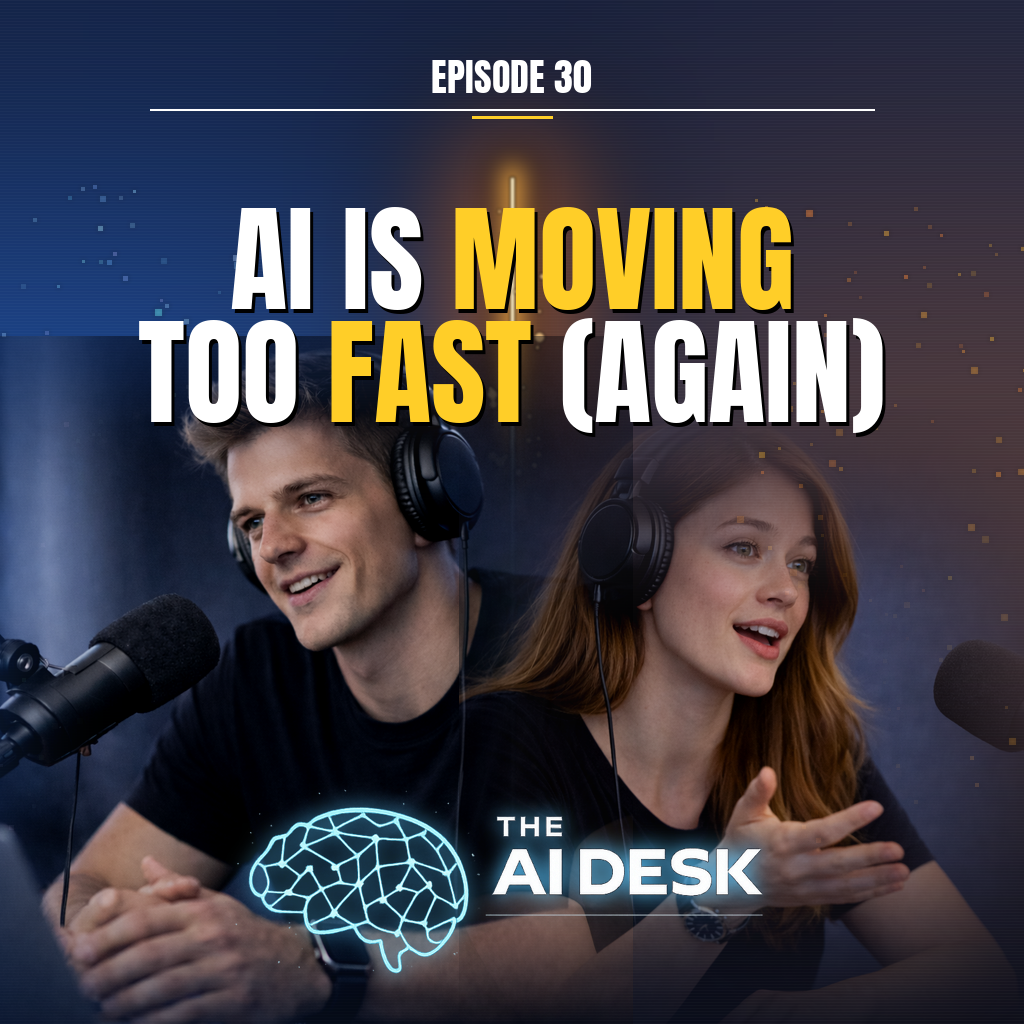
AI Is Moving Too Fast (Again): Breaking Down This Week's Major AI Developments
If you've felt like the AI landscape is accelerating faster than ever, you're not imagining it. In Episode 30 of The AI Desk Podcast, hosts Rowan and Naya tackle why AI is moving too fast and what it actually means for the tools you use every day.
From rapid-fire model updates to agent-like AI that can complete multi-step tasks, the industry is hitting fast-forward. But with greater capability comes greater complexity—and some uncomfortable questions about control, security, and responsibility.
Why Everything Feels Like It's Accelerating
The AI acceleration isn't a gradual shift. It's a pile-up.
Every major AI company—OpenAI, Google, Anthropic—is pushing updates simultaneously while competing aggressively for market dominance. This competitive pressure means faster iteration cycles, more frequent releases, and constantly evolving capabilities.
The result? It's nearly impossible to keep up. What was cutting-edge last month feels standard today.
Two Major Shifts Happening Right Now
Better Reasoning, Not Just Answering
Modern AI systems are moving beyond pattern matching and surface-level responses. They're developing genuine reasoning capabilities—working through problems step by step rather than generating quick answers.
This represents a fundamental shift in how AI approaches tasks. Instead of guessing, it's thinking.
AI Is Becoming Agent-Like
Perhaps the most significant change is the rise of agent-like AI. Rather than simply responding to prompts, these systems can accept a goal and autonomously complete multiple steps to achieve it.
This transforms AI from a reactive tool into something closer to a collaborator. Instead of "write me an email," you can ask AI to "handle this workflow," and it manages the entire process.
The Security Question Everyone's Asking
This week brought headlines about AI finding system vulnerabilities and mapping potential attacks. The concern is real—but the picture is more nuanced than "AI is hacking things."
How It Actually Works
Researchers are testing AI in controlled environments (simulated networks) and asking systems to identify security weaknesses. The AI scans code, analyzes connections, and identifies vulnerabilities—essentially performing automated ethical hacking.
The Double-Edged Sword
The benefit is clear: security defenders work faster. Detection and remediation become quicker, more efficient, and more scalable.
The risk? It lowers the expertise barrier. Finding vulnerabilities still requires intent, but less technical knowledge. The capability scales in both directions—helping defenders and potentially helping attackers.
As Naya put it: "You still need intent—but less expertise."
Business Shifts: Competition Intensifies
Beyond technical capabilities, the business landscape is shifting rapidly.
- **OpenAI and Microsoft are less tightly coupled**, creating more independence and competition
- **Big tech companies are deepening government partnerships**, sparking internal employee pushback
- **New alliances are forming**, driving faster product releases across the industry
These dynamics mean more products, more competition, and more pressure to innovate quickly.
The Frustrating Paradox: Capable Yet Unreliable
Here's the tension that defines AI right now: systems can reason, plan, simulate attacks, and complete complex workflows—yet still struggle with basic instructions like "be concise."
Capability and reliability aren't the same thing. AI can be simultaneously extremely powerful and occasionally ridiculous.
What This Actually Means for You
The core takeaway isn't whether AI is dangerous or beneficial. Instead, the real question is: How do we use AI responsibly while it's evolving this rapidly?
The answer requires balancing innovation with oversight, capability with safety, and speed with thoughtfulness.
Key Takeaways
- AI is accelerating due to simultaneous competition from every major player
- New agent-like capabilities allow AI to complete multi-step tasks autonomously
- AI can identify security vulnerabilities faster than humans—improving defense and lowering attack barriers
- Business alliances are shifting, intensifying competition and product releases
- Capability and reliability are separate—powerful systems can still make basic mistakes
- The real challenge isn't controlling AI power, it's governing its responsible use during rapid evolution
---
About The AI Desk
The AI Desk is a weekly podcast dedicated to cutting through AI hype and explaining what's actually changing in artificial intelligence. Hosts Rowan and Naya break down complex developments into actionable insights for everyday users, covering everything from model capabilities to business implications to real-world implications. New episodes drop weekly.