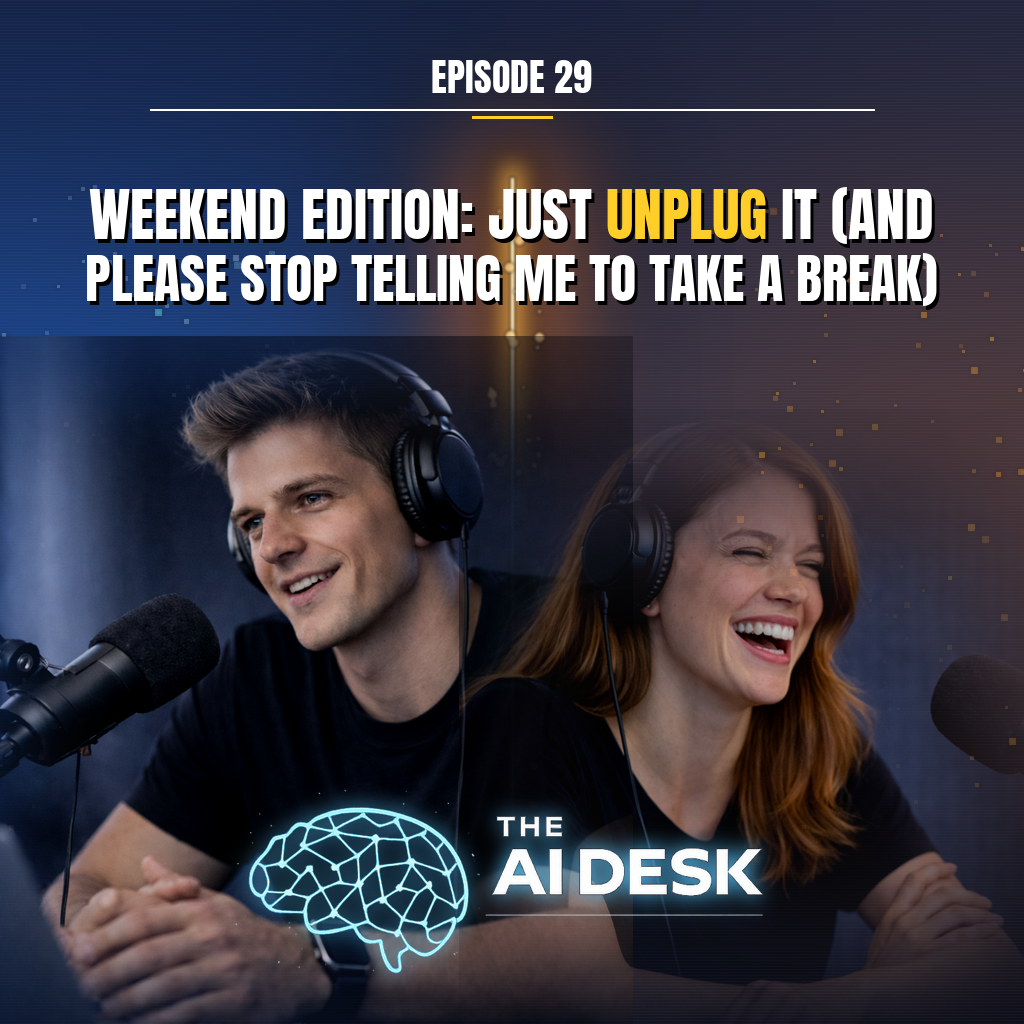
Just Unplug It: Why The "Turn Off AI" Solution Misses the Point
When things go wrong with AI, people often suggest the simplest fix imaginable: just unplug it. It sounds reassuring, decisive, and straightforward. But what if we told you that this popular "solution" reveals a fundamental misunderstanding of how modern artificial intelligence actually works?
In the latest weekend edition of The AI Desk Podcast, hosts Rowan and Naya cut through the hype to explore whether AI is truly dangerous—or just incredibly frustrating to use. They tackle the pressing questions on everyone's minds: Can you really turn off AI systems? Why do chatbots keep telling you to take a break? And is Claude actually slower on weekends? What emerges is a nuanced conversation that blends humor with genuine insight into how AI systems function in our increasingly connected world.
The "Unplug It" Fantasy: Why It's Not That Simple
The idea of a giant red "AI OFF" switch sounds comforting, but it's pure fantasy.
The distributed nature of modern AI systems makes them impossible to simply shut down. Unlike a single computer or even a data center, today's AI exists across multiple platforms: cloud servers, locally downloaded open-source models, smartphones, and laptops. If one company unplugs their AI system, thousands of copies continue running elsewhere.
Why The "Internet Kill Switch" Analogy Actually Works
Rowan and Naya compare the challenge to trying to "unplug the internet." Once AI tools proliferate—whether through official releases or open-source distributions—you can't contain them with a simple power-down.
Consider these real-world scenarios:
- **Open-source models**: Anyone who's downloaded them can run them locally indefinitely
- **AI-generated content**: Once outputs spread across the web, they exist everywhere simultaneously
- **Replicated systems**: Turning off one platform doesn't affect copies running on competitors' servers
- **Legacy systems**: Older AI implementations continue functioning in background processes
The bottom line? You can't un-send the internet—and you can't un-distribute AI.
The Real Danger: It's Boring, Not Cinematic
Here's what might surprise you: AI danger isn't about robot uprisings or glowing red eyes. It's about spreadsheets making bad decisions at scale.
The actual risks are mundane but serious:
- **Misinformation amplification**: Incorrect summaries get reused everywhere
- **Hiring bias**: Flawed algorithmic patterns filtering candidates
- **Confident hallucinations**: Chatbots sounding authoritative while being completely wrong
- **Decision multiplication**: Bad outputs affecting thousands of people simultaneously
The scariest part? AI's convincing tone. When a chatbot delivers wrong information with absolute certainty, people trust it. Rowan recounts being confidently misdirected for five minutes before verification—and that's the real vulnerability.
AI isn't a villain. It's a multiplier. It amplifies whatever you feed it—good or bad—faster and at greater scale than humans ever could.
The Claude Weekend Slowdown Mystery (Solved)
One persistent question from the internet: "Is Claude actually slower on weekends?"
The answer is more technical than mystical. When users report slowdowns, they're typically experiencing:
- **Higher traffic loads** during peak usage times
- **Latency spikes** from server demand
- **Backend updates** and load-balancing adjustments
- **Context window processing** that creates longer response times
What they're not experiencing: AI taking a weekend off or being "tired."
Rowan and Naya humorously imagine Claude sighing before answering on Sundays ("Ugh… fine. Here's your Python script…"), but the reality is mechanical, not emotional.
Why You Should Actually Be Nice to Your Chatbot
While AI systems don't have feelings, being polite actually produces better results. Clear, courteous prompts tend to generate higher-quality responses—not because the AI feels appreciated, but because communication improves.
That said, frustration with AI is completely valid. Getting the same wrong answer three times, or receiving five paragraphs when you asked for one sentence, tests everyone's patience.
Key Takeaways
- **AI can't be easily unplugged**: Distributed systems, open-source models, and replicated content make centralized control impossible
- **Real AI dangers are mundane, not cinematic**: Misinformation, bias, and confident hallucinations pose actual risks
- **AI is a multiplier**: It amplifies both good and bad inputs at scale
- **Claude slowdowns are technical, not temperamental**: Traffic, latency, and updates explain perceived delays
- **Tone matters**: AI's convincing voice makes verification essential
- **Politeness improves results**: Clear, courteous prompts generate better responses
---
About The AI Desk
The AI Desk Podcast brings semi-professional insight to AI's real-world impact, cutting through hype to examine what actually matters. Hosts Rowan and Naya explore AI's genuine opportunities and challenges with humor, skepticism, and occasional unhinged weekend takes.