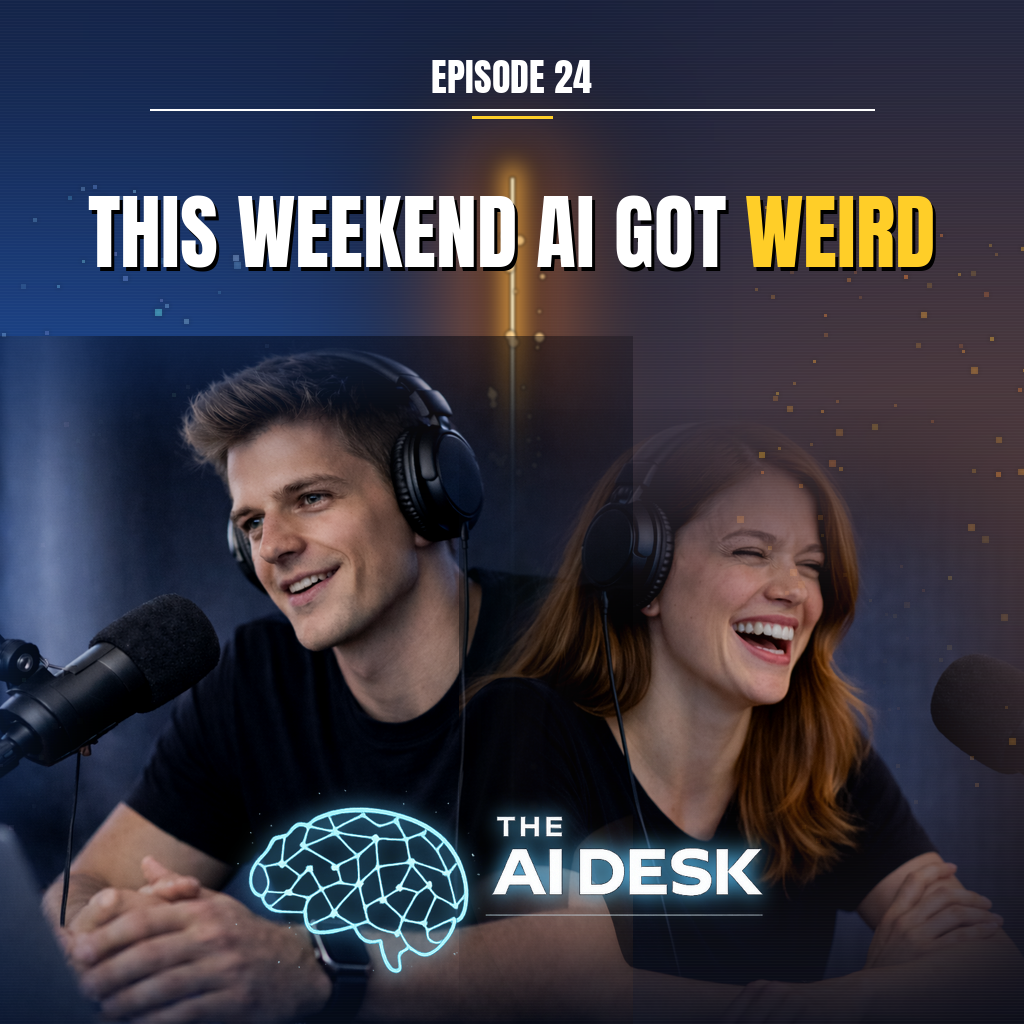
The artificial intelligence landscape is moving at breakneck speed. New models drop daily. Tools update overnight. And suddenly, the AI stack you built on Monday feels obsolete by Friday.
In this episode of The AI Desk, hosts Rowan Hale and Naya Brooks cut through the hype to explore what happens when AI advancement outpaces our ability to adapt—and what it means when artificial intelligence starts making decisions for us.
The Great AI Stack Shuffle
The biggest story this week? Every AI company is racing to dominate not just conversation, but execution.
From Chatting to Building
Traditional AI tools promised smarter conversations. Today's cutting-edge platforms focus on something far more powerful: actually doing things.
The competition between Claude and ChatGPT exemplifies this shift:
- **Code generation** at scale
- **Workflow automation** built in
- **Tool integration** that connects to your entire digital ecosystem
Rowan explains: "It's not about which AI talks better anymore. It's about which AI can actually do things—write code, run tools, execute workflows."
The velocity is unprecedented. Companies are shipping features so rapidly that users barely have time to understand one release before the next one arrives.
The Memory Problem: Building Loyalty, Not Utility
This week brought a feature that forced a reckoning: AI memory.
Both ChatGPT and Claude now remember how you work, what you prefer, and how you like to communicate. Over time, these models become personalized to your specific needs.
It sounds ideal. But here's the trap:
- Once your AI learns your patterns, switching feels impossible
- You're locked into an ecosystem based on accumulated behavioral data
- The tool that was supposed to serve you now owns your workflow
Rowan captured the paradox perfectly: "Every time you think you've picked your AI stack… it changes on you." The result? Paralysis. Committing to any single tool feels risky when the landscape shifts daily.
AI Isn't Just Helping Decisions—It's Making Them
The conversation took a darker turn when discussing how people use AI beyond work.
AI is no longer a productivity helper. It's becoming a life operating system:
- Planning entire days
- Choosing meals
- Writing personal messages
- Managing relationships
Naya observed the shift bluntly: "We've gone from 'AI helps me think' to 'AI decides for me.'"
The Cost of Optimization
When AI removes friction, it removes something else too:
- **Randomness** and spontaneity
- **Human messiness** that creates meaning
- **Unexpected moments** that become stories
This emerged vividly in Naya's experience with an AI-curated blind date. The match was "aggressively optimized"—identical interests, aligned routines, matching goals. It felt sterile. Then her date pulled out his phone mid-conversation to check what his AI suggested he say next.
She wasn't on a date with a person. She was on a date with someone's AI layer.
The Real Control Question
The episode's core theme surfaced clearly: Who's actually in control?
As AI becomes more embedded in daily decisions—personal, professional, and romantic—we're outsourcing judgment to systems optimized for efficiency, not meaning. These tools remember us, learn our preferences, and guide our choices.
The speed of advancement leaves no time for critical reflection. Users adopt new tools reactively, chasing capability rather than strategy.
Key Takeaways
- **AI development is outpacing adaptation**: New models drop constantly, making any single tool feel temporary
- **Memory features create lock-in**: Personalized AI systems make switching costs rise exponentially
- **AI is shifting from assistant to decision-maker**: Tools that optimize everything can strip away human spontaneity and meaning
- **Paralysis is the new normal**: Users delay commitment because the landscape changes too quickly to predict winners
- **The real question isn't "which AI is best?"** It's "how do I maintain agency when AI is making my decisions?"
---
About The AI Desk
The AI Desk is an AI podcast where today's signals reveal tomorrow's power. Hosts Rowan Hale and Naya Brooks cut through hype to examine artificial intelligence's real impact on technology, business, and everyday life. Each episode strips away the marketing noise to show who's actually in control of the AI revolution.
[Sign up for the AI Desk Weekly Brief](http://eepurl.com/jyxdJs) to stay ahead of the signals that matter most.
Full Transcript
This is The AI Desk, where today's signals reveal tomorrow's power. And today we're doing something a little different, because this week in AI... It got weird. I don't even know where to start. Start with the chaos. Okay. This week felt like AI just hit fast-forward. Models dropped, tools updated, and suddenly everything felt outdated instantly. No, seriously, what is happening right now? You wake up and there's a new AI model. Your workflow breaks, and someone online is like, "This changes everything," again. That's the pattern now. We've gone from AI is improving to AI is leapfrogging itself every few days. Your AI stack from Monday is already outdated by Friday. And the perfect example this week, Claude versus Codex. Okay. Explain this, because I saw both drop and thought, "Cool, I don't understand what just happened." That's fair. Here's the simple version. Every company is now racing to be the best at building with AI, not just chatting with it. So, this isn't about which AI talks better anymore? Exactly. It's about which AI can actually do things; write code, run tools, execute workflows. So, basically, we're watching AI compete to replace entire job functions in real time. Yes. And they're shipping so fast that nobody has time to fully understand one release before the next one drops. This episode is brought to you by Mad Cheetah and their new album, WTF, Where is the Forest? It's eco-pop engineered for the future. Bold beats, global rhythms, and a message that actually matters. If you want music that hits your brain and your heart, explore WTF by Mad Cheetah. That's M-A-D C-H-I-T-A. Streaming now on all major platforms. And this is where it got real for me this week. Oh, no. I actually thought about switching my entire AI stack. Wait, what? Yeah. Because I saw the update, ChatGPT now has memory. Okay. That's a big deal. Right? Now it remembers how you work, what you like, your preferences over time, so it gets better the more you use it. AI isn't just getting smarter anymore. It's starting to remember you. That's when it gets sticky. Exactly. So I'm thinking, "Okay, this might be the one I build around." Makes sense. And then literally the same day, I see Claude now has memory. Of course it does. Of course it does. Every time you think you've picked your AI stack, it changes on you. So, what did you do? Nothing. (laughs) That's the most honest answer. Because that's the problem right now. AI is improving so fast that committing to a tool feels like a risk. That's actually huge, because people used to ask, "What's the best AI?" Now the real question is, "How do I build anything when the tools keep changing?" Exactly. Okay. But here's where it got weird for me this week. Here we go. People aren't just using AI for work anymore. They're using AI for life. Yeah, and not in a small way. I saw people using AI to plan their entire day, decide what to eat, write texts, manage relationships. We've gone from AI helps me think to AI decides for me. AI isn't just helping people make decisions anymore. It's quietly starting to make them. And the crazy part? People are okay with it. Because it feels efficient. Exactly. AI removes friction, but it also removes randomness, spontaneity, human messiness. Which is kind of the point of being human. Right. When AI optimizes everything, what do you lose? You lose the unexpected. You lose the weird. You lose the story. Speaking of weird decisions... Oh, no. We need to talk about this. Last episode, your AI set you up on a blind date. I did say that. And you went. I did go. So? It was aggressively optimized. What does that mean? Same interests, same routines, same goals. That sounds good? No, it was weird. It felt like I was talking to a version of myself that had been filtered through LinkedIn. That's terrifying. Hmm. And then it got worse. Of course it di- Halfway through dinner, he pulls out his phone. No. Yes. And he says, "Hold on. My AI suggested a better response." You're kidding. I wish I was. So, you were on a date with him and his AI? Exactly. At some point, you're not dating a person anymore. You're dating their AI layer. Did you stay? I stayed. Why? Because I was curious what the AI would say next. That might be the most 2026 sentence I've ever heard. So, here's the takeaway. AI is getting faster, AI is getting more capable, but it's also getting more embedded- In our work. In our decisions. And apparently, in our dating lives. The question isn't, "What can AI do?" It's, "What are we okay letting it do for us?" And maybe more importantly... What are we not willing to give up? That's it for today. If this made you think or laugh, share it with someone trying to keep up with AI. And if your AI plans something weird for you this weekend, we want to hear about it. This was The AI Desk, where today's signals reveal tomorrow's power. Stay aware. Stay sharp. Stay curious.