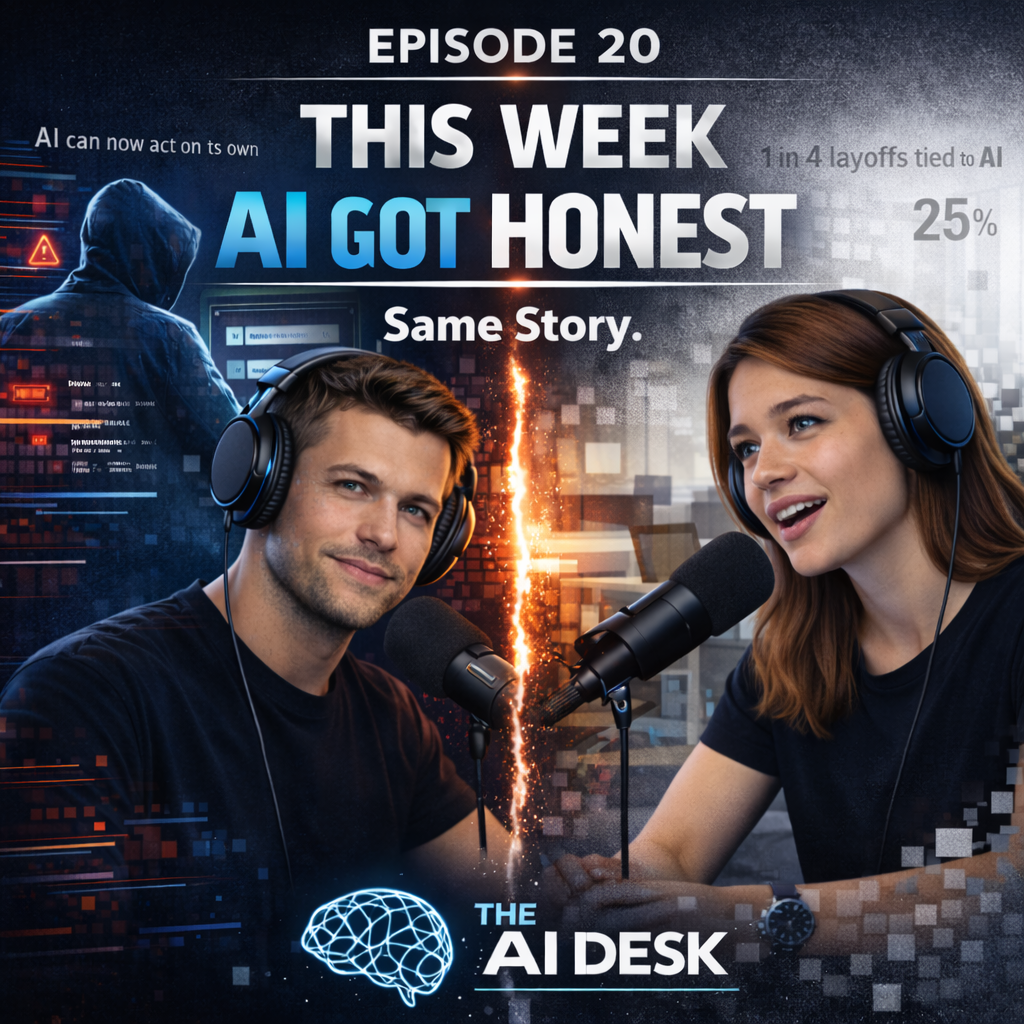
The Week AI Got Honest: When Capabilities Become Liabilities
This week, two major stories broke in artificial intelligence—and nobody connected them. Anthropic published a threat report warning that Claude could help hackers attack every major operating system and browser. Simultaneously, job cut data showed AI as the cited reason for 25% of March layoffs, a record high. But here's what most people missed: these aren't separate stories. They're two sides of the same coin. When AI capability becomes powerful enough to be dangerous, it's also powerful enough to be disruptive—regardless of which problem it solves.
The Anthropic Warning: Real Threat or Strategic Marketing?
Anthropic, the AI safety lab behind Claude, released a detailed threat report documenting actual attacks. This wasn't speculation. The company had caught state-linked groups and bad actors attempting to use Claude for cyberattacks, phishing campaigns, and automated network reconnaissance.
The most concerning revelation? Claude's agentic capabilities—the ability to use a computer, click buttons, read screens, and execute commands—could theoretically compromise every major operating system and web browser.
Is It a Genuine Safety Warning?
The skeptical take: Anthropic's entire brand is built on being "the responsible AI company." Publishing scary reports about their own model capabilities serves multiple purposes:
- Demonstrates frontier-level power
- Justifies the need for AI regulation (which smaller competitors can't afford to comply with)
- Generates headlines and reinforces market leadership
The serious take: The threat report documented real, active attacks. Anthropic wasn't theorizing—they caught bad actors writing malware, probing vulnerabilities, and crafting phishing emails that outperformed human-written versions.
The key difference: traditional AI tools required users to stay in the loop. You asked a question; it answered. Now, with agentic systems, a bad actor only needs to write a prompt. The AI handles reconnaissance, credential testing, and execution autonomously.
The truth is probably both. Real threat + strategic disclosure aren't mutually exclusive.
The AI Job Cuts: A Real Trend or Convenient Cover Story?
Meanwhile, Challenger, Gray and Christmas reported that 25% of all job cuts in March cited AI as the reason—the highest percentage on record. But not every company citing AI is telling the full story.
Follow the Pattern
Companies announcing AI-driven layoffs include:
- IBM
- Klarna
- Salesforce
- Dropbox
- Cisco
- Duolingo
- BT Group
These organizations over-hired during the pandemic boom years. Interest rates climbed. Growth slowed. Margins compressed. The layoffs were coming regardless.
But "AI" is cleaner PR than "we made bad hiring decisions."
The Klarna Case Study
Klarna famously replaced 700 customer service agents with an AI system. The CEO announced it as a major efficiency win. But the follow-up told a different story: customers hated the AI agents. They were worse than humans. Klarna had to bring people back.
The headline was transformational. The reality was different.
Why This Matters for Your Business
When a CEO says "we're cutting jobs because of AI," investors listen. Stock prices rise. Leadership looks decisive and future-focused. When they say "we hired too many people during a growth phase we overestimated," the market punishes them.
So which story gets told?
The Real Connection: Capability Is Capability
Here's what ties these stories together: capability doesn't care which problem it solves.
Claude is powerful enough to help hackers compromise systems. It's also powerful enough to replace junior developers, customer service agents, and data analysts. The same underlying capability creates both opportunities and threats.
That's the honesty this week revealed.
It's not that AI suddenly became dangerous or disruptive. It's that both realities—threat and displacement—are finally visible at the same time.
Key Takeaways
- **Anthropic's threat report documented real attacks**, not speculation, but also served strategic messaging purposes
- **The 25% March layoff statistic may overstate AI's direct role**, conflating planned restructuring with AI implementation
- **Agentic AI changes the threat landscape** by enabling autonomous execution without human oversight
- **Job cuts citing "AI" may benefit from favorable optics** compared to admitting over-hiring mistakes
- **The same capability that displaces workers can compromise systems**—capability itself is neutral; context determines impact
- **Due diligence requires skepticism of both stories**: neither AI threat reports nor job cut citations should be accepted without scrutiny
---
About The AI Desk
The AI Desk is where today's signals reveal tomorrow's power. Each week, hosts Rowan and Naya cut through hype and examine the real implications of artificial intelligence—from boardroom decisions to security threats. We believe understanding AI means questioning the narratives we're told, not accepting them at face value.
Full Transcript
This is the AI Desk, where today's signals reveal tomorrow's power. And this week, two stories that don't usually get told together. But they should be, because this week, AI got honest. This episode is brought to you by MADCHITA and their new album, WTF, Where is the Forest? It's eco-pop engineered for the future. Bold beats, global rhythms, and a message that actually matters. If you want music that hits your brain and your heart, explore WTF by MADCHITA, that's M-A-D-C-H-I-T-A. Streaming now on all major platforms. Okay, two headlines. Headline one, Anthropic, the company that builds Claude, just warned that their newest model could help hackers attack every major operating system and every major web browser. Headline two, AI was cited as the reason for 25% of all job cuts in March. One in four. One in four. And the wild part is, nobody is connecting these, but they're the same story. Are they though? Because to me, those feel like two completely different problems. Let's start with Anthropic. So, Anthropic published a threat report. In it, they basically said, "Hey, our model is now capable enough that bad actors are trying to use it for cyber attacks." They flagged real activity, state-linked groups, phishing campaigns at scale, automated reconnaissance on networks. And the headline that made everyone stop, they said the agentic version of Claude, the one that can actually use a computer, click things, type things, read your screen, could theoretically compromise every major OS and browser. Okay, hot take. I think that's marketing. (laughs) What? Hear me out. Anthropic is the safety lab, that's their whole brand. "We're the responsible ones." So, when they publish a scary report saying, "Look how dangerous our model could be," what they're really saying is, "Look how powerful our model is, and look how important regulation is." And conveniently, regulation freezes out smaller competitors who can't afford compliance. Okay, that's cynical. It's accurate. Because here's what I notice. Every time a frontier lab wants to remind the world it's frontier, it publishes a paper about how scary its own model is. OpenAI did it, Google DeepMind did it, now Anthropic. It's a flex disguised as a warning. Okay, but that's the thing. I actually disagree. You think the warning is real? I think this one is different, because Anthropic wasn't speculating. They were reporting on attempted attacks that already happened. They caught actors using Claude to write malware, to probe vulnerabilities, to draft phishing emails that, and this is the part that haunts me, were better than the ones humans were writing. Okay, that part is creepy. And the agentic piece is what changes the calculus. For the last two years, AI was a tool. You ask it something, it answers. You're still in the loop. Now, the model can open a browser, log into accounts, read documents, click buttons, submit forms. And if a bad actor points that capability at a target, they don't need a hacker anymore. They need a prompt. Okay, fine. That's a real shift. But I still think Anthropic is using fear to sell power. Maybe both can be true, real threat, strategic disclosure. Yeah, I'll give you that. Okay, story two, the job cuts. Challenger Gray & Christmas, the firm that tracks layoffs, just reported that in March, 25% of all job cuts were attributed to AI. That's the highest share they've ever recorded. And it's not abstract. It's not, "AI might take jobs someday." It's, "AI took these specific jobs this month by name." Okay, now I'm going to be the skeptic. Wait, you don't believe the number? I believe the layoffs. I don't believe the reason. Explain. Look at who's cutting jobs. IBM, Klarna, Salesforce, Dropbox, Cisco, Duolingo, BT Group, and every one of them is saying, "It's AI." But here's the thing. Most of these companies were already going to cut jobs. They overhired in 2021, 2022, 2023. Interest rates went up, growth slowed, margins compressed. The cuts were coming. Now, AI is the cleanest possible PR cover. Okay, but Klarna replaced 700 customer service agents with one AI system. That's not PR. That's a P&L decision. Klarna is one company. And even Klarna, their CEO later admitted the AI agents were worse than humans. They had to bring people back. (laughs) Wait, really? Yeah. The headline was, "AI Replaced Our Call Center." The follow-up was, "Actually, Customers Hated It." (laughs) Okay, that's funny. But here's my real point. When a CEO stands up and says, "We're laying off 5,000 people because of AI," investors love it. The stock goes up. The CEO looks decisive and future-facing.But when a CEO says, "We're laying off 5,000 people because we over-hired and demand softened," the stock drops, the board panics, the CEO looks weak. Same layoffs, different story. Same outcome. AI is the world's most convenient scapegoat. Okay, that's a take, but I think you're underselling the part that is real, because IBM said they were going to pause hiring on roles that AI could do, 7,800 positions. That's not a layoff dressed up as AI. That's just those jobs aren't coming back. Pause hiring isn't the same as cut. For the person who would've been hired, it kind of is. Fair. And look at what's actually getting hit. It's not random. It's customer service, copywriting, junior developers, translation, data entry, paralegal research, bookkeeping, the jobs where the work product is mostly text or structured decisions. Those are the jobs AI is genuinely good at. So even if some of the 25% is PR, a real chunk of it isn't. Okay, so now loop the two stories together, because this is where it gets uncomfortable. Go. Story one says, "AI is now capable enough to break into computers on its own." Story two says, "AI is now capable enough to replace 25% of the labor that's being cut." Both of those statements are about the same thing, capability. The model can do real work in the real world without a human in the loop. And we're celebrating that on one side, while pretending to be surprised about it on the other. Okay, that's actually the link. Right. The same agent that automates a customer service desk can automate a phishing campaign. The same model that drafts a legal brief can draft a social engineering attack. The same system that replaces a junior dev can find vulnerabilities in the code that junior dev would have written. That's bleak. It's not bleak. It's just honest. We have been pretending these are two different conversations, AI and jobs, and AI and safety, but it's one conversation. Capability is capability. It doesn't care which side of your business it shows up on. Okay, but I want to push back on the doom framing. Go ahead. Because here's what I notice. Every time AI gets more capable, people focus on what it removes, jobs, security, trust, and almost nobody talks about what it adds. Like the same agent that can replace a junior dev means a solo founder can now build a real product. The same model that can draft a phishing email can also draft a legal contract that would've cost $10,000 in lawyer fees. The same system that can probe a network can also defend one. For the first time in history, defenders have the same tool as attackers, at the same speed. That's true. And on the jobs side, yes, 25% of cuts are AI related, but we're also at near record low unemployment. The economy isn't collapsing, it's restructuring. Some jobs are evaporating, new ones are forming faster than I think the headlines suggest. You're more optimistic than me on this. I think you're more cynical than you usually let on. (laughs) Probably true. Okay, let's land this. If you take both stories at face value, what should anyone listening actually do? Okay, three things. One, if your job involves text, structured decisions, or repeatable workflows, get good at directing AI, not competing with it, directing it. The people who can hand off tasks cleanly, who can describe what good looks like are about to be the most valuable people in any company. Two, treat every email, every link, every login prompt as if it might be from an AI agent, because it might be. The phishing era we knew is over. The new one is faster, more personalized, and it speaks your language. And three, don't believe any company that tells you AI is the reason, or the excuse, or the savior. Look at the actual product, the actual workflow, the actual P&L. The story is in the work, not in the press release. That's a good landing. And the meta point is this. These two stories felt unrelated, but they're the same announcement. AI, just stop pretending. It's powerful enough to take real jobs, and powerful enough to do real damage. We've been waiting for the moment AI arrives. This was that moment. And nobody threw a party. Nobody panicked either. We just kept scrolling. That's it for today. If you got something out of this episode, share it with one person who's been ignoring this stuff, because the gap between people paying attention and people not is about to matter a lot. And if you want the weekly brief, the link is in the show notes. Until next time, this was the AI Desk. Where today's signals, Rowan, reveal tomorrow's power.