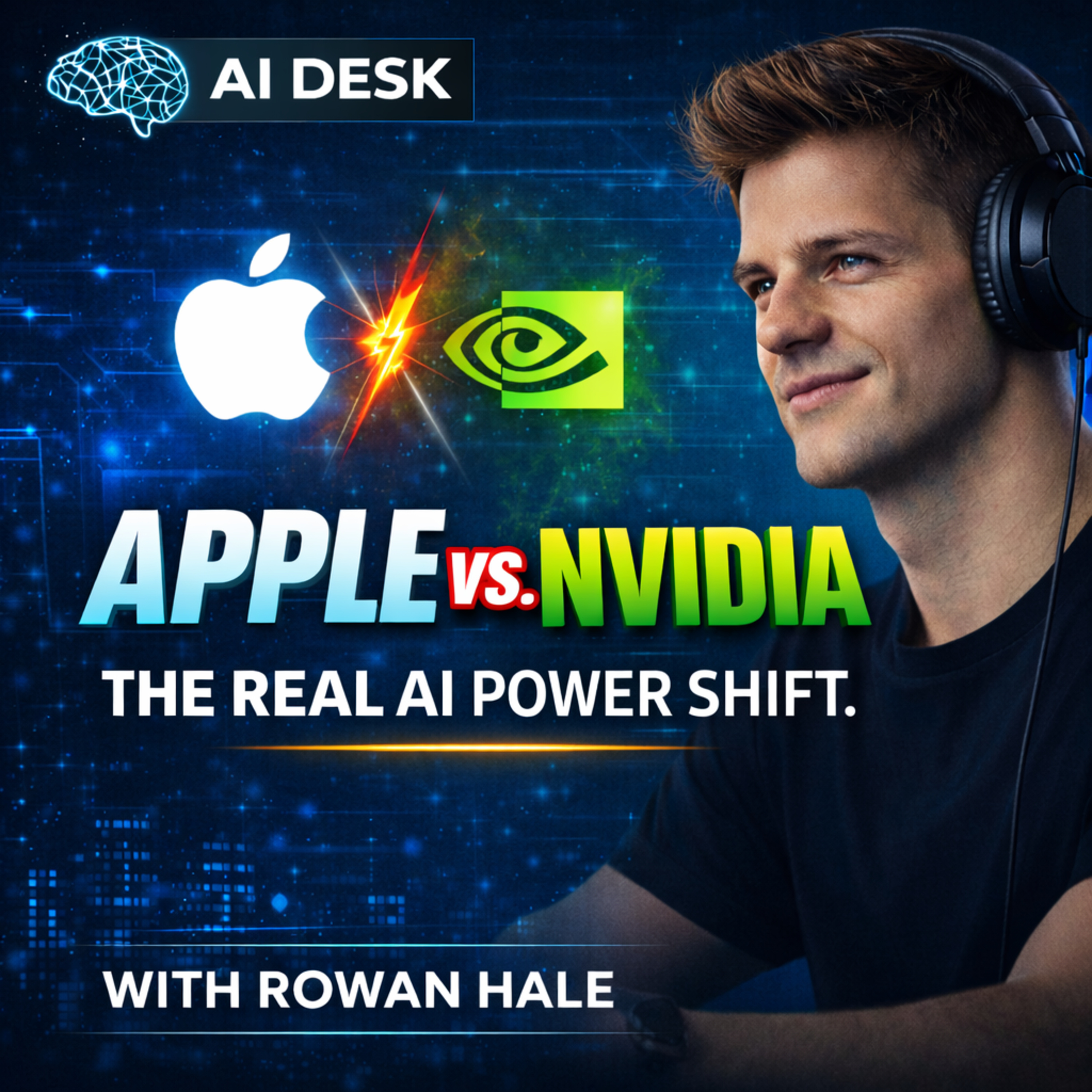
Apple vs NVIDIA: The Real AI Power Shift Nobody's Talking About
While Silicon Valley obsesses over the latest language models from OpenAI and Google, a far more consequential battle is unfolding in the shadows. The real AI power shift isn't about who builds the smartest models — it's about where AI actually runs, and who controls it. This fundamental transformation pits Apple's emerging on-device intelligence strategy against NVIDIA's centralized, data-center-driven approach. Understanding this shift is crucial for anyone trying to cut through the AI hype and see where real power is consolidating.
The Two Competing Visions for AI's Future
The AI industry stands at a crossroads defined by two radically different architectures. One path leads to your device; the other leads to the cloud.
NVIDIA's Path: Centralized Cloud Dominance
NVIDIA didn't set out to become the backbone of the AI revolution. The company's journey from gaming GPUs to AI infrastructure tells a remarkable story of strategic positioning.
Graphics processing units were originally designed to render pixels faster. But GPUs possessed a unique superpower: they could perform thousands of calculations in parallel — exactly what machine learning algorithms need. When deep learning exploded, NVIDIA's hardware became irreplaceable.
Today, nearly every major AI model runs on NVIDIA GPUs in massive data centers. Whether it's training GPT-4, Claude, or Gemini, cloud providers depend on NVIDIA's chips. This creates a compelling business model: centralized infrastructure means predictable revenue, pricing power, and technological lock-in.
Key advantages of the centralized model:
- Enormous computational resources for training massive models
- Standardized infrastructure across cloud providers
- Significant switching costs once deployed
Apple's Path: Distributed, On-Device Intelligence
Apple is pursuing a fundamentally different strategy. Rather than pushing all intelligence to the cloud, Apple is embedding increasingly powerful AI capabilities directly into devices — iPhones, Macs, and iPads.
This isn't just a hardware play. It represents a philosophical shift about where the intelligence layer of computing should live. With on-device AI, processing happens locally. Your data stays on your device. You maintain control.
Key advantages of the distributed model:
- Privacy by default — no data leaves your device
- Lower latency and faster response times
- Reduced dependence on internet connectivity
- User control over data and functionality
Why This Battle Matters More Than You Think
The location of AI processing has profound implications beyond technology.
Privacy and Control: Centralized models require data transmission. On-device AI keeps sensitive information local. As privacy regulations tighten globally, this advantage compounds.
Cost Structure: Data centers consume enormous electricity and require constant upgrades. On-device processing distributes costs across millions of devices, each doing less work individually but collectively handling massive compute volumes.
Economic Power: Whoever controls where AI runs controls the economic value. NVIDIA currently extracts rent from every AI inference happening in the cloud. Apple extracts value by making devices indispensable to daily intelligence tasks.
Geopolitical Implications: Centralized AI infrastructure is easier to regulate, monitor, and control. Distributed AI is harder to surveil or restrict — but also harder to govern.
The Shift Is Already Underway
Recent developments suggest this isn't theoretical:
- Apple's Neural Engine improvements across device generations
- Major language model quantization efforts making large models device-feasible
- Growing privacy concerns driving enterprise interest in on-device solutions
- Increasing costs of cloud inference creating economic pressure for alternatives
The question isn't whether on-device AI will gain share — it's how quickly, and what that means for NVIDIA's dominance.
Key Takeaways
- **Two competing architectures:** NVIDIA controls centralized cloud AI; Apple is building distributed, on-device intelligence
- **The real power shift** isn't about better models, but about controlling where and how AI executes
- **Privacy and cost** create structural advantages for on-device approaches as AI matures
- **This is the most important AI battle** happening outside the headline-grabbing model announcements
- **Understanding where AI lives** matters more than which company released the latest chatbot
---
About The AI Desk
The AI Desk explores the structural forces reshaping technology, business, and global markets. Host Rowan Hale breaks down complex technological and economic trends with analytical precision, helping listeners anticipate where leverage and opportunity are moving next. Each episode cuts through hype to examine the signals that actually matter.